
Social Media and The Rot of Sports
Well, it’s not just sports. Social media has completely changed the way people are comfortable talking to and about one another.
As recently as 20 years ago, you had to do a cost-benefit analysis before running your mouth in a disagreement. Am I going to get my point across? Is the person I’m arguing with going to stab me in the spleen if I take this too far? It was a more peaceful time.
Now, any yahoo can make an anonymous Twitter account with a cartoon avatar and say anything they want with impunity. Sure, an enterprising sleuth could trace an IP address and figure out who’s behind @VolleyballDad42069, but then what? Knock on their door and ask them to repeat what they said about your favorite fighter’s chin? Enjoy prison, hero.
The Reiner de Ridder Lesson
Last week, Reiner de Ridder took on Brendan Allen in a five-round MMA fight. De Ridder was the betting favorite — supposed to win, supposed to dominate. He started fast, probably even took the first round. Then it all went sideways. He gassed. Allen mauled him for three straight rounds. Rather than send their fighter out to continue getting concussed, De Ridder’s corner did the humane thing and threw in the towel.
Immediately, the narrative metastasized: De Ridder quit on his stool.
That’s the cardinal sin in fighting — worse than getting flatlined, worse than tapping to a choke. Fighters can live with losing. They can’t live with being branded soft. And Twitter — the digital Colosseum of the talentless — turned into a feeding frenzy.
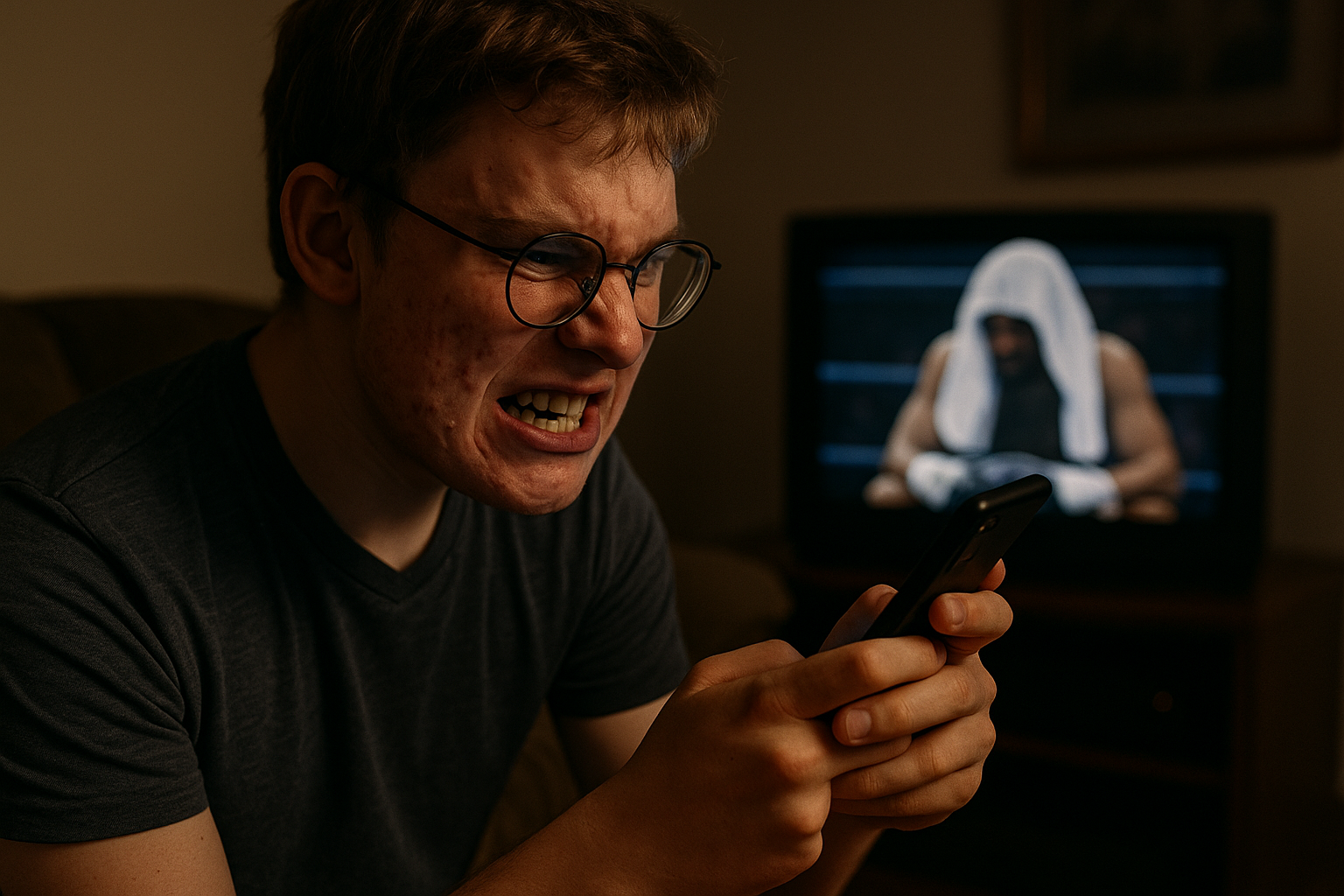
People who need a motorized scooter to buy cookie dough ice cream were calling Reiner de Ridder a pussy. Imagine that: a guy whose most violent act in the last decade was slapping his kid’s iPad out of their hands suddenly fancies himself a gatekeeper of toughness.
The Part They Didn’t Mention
As it turns out, De Ridder was anything but a coward. He’d spent fight week battling Norovirus — which, if you’ve ever had it, sits somewhere between mono and a slow death by acid reflux. Try breathing with a boa constrictor wrapped around your ribs while someone lights a bucket of turpentine under your nose. That’s Norovirus.
To make things worse, De Ridder broke bones in his hand in the first round. He couldn’t punch properly. Couldn’t grip for takedowns. Couldn’t do what he’s made a career of doing — and he still went three more rounds before his corner saved him.
If anyone ever earned the right to sit on their stool, it was Reiner de Ridder. But sure, let’s call him names from behind a Wi-Fi signal.
The Cult of the Cowardly Chorus
Social media’s the only place on Earth where courage is measured in bandwidth. Nobody’s ever torn a ligament from throwing shade, or broken a hand typing “glass jaw.” The De Ridder fiasco wasn’t analysis — it was a mass performance of delusion. The world’s most sedentary mob deciding what bravery looks like from their couch.
These are the same dudes who call sports radio to say, “If it were me, I’d have kept swinging.”
Yeah, man, and if it were you, they’d still be scraping you off the canvas with a Swiffer WetJet.
Pain is content now. Suffering is trending. A fighter pukes in a bucket between rounds, and it’s on a loop before the sweat hits the mat — GIFs, memes, think-pieces. Everyone’s an expert. Nobody’s empathetic.
Sixty Seconds
So here’s my modest proposal: Say whatever you want. Post your fire emoji takes. But if you call a professional fighter a coward — from behind your Naruto avatar, your egg profile, your alias of bravery — and somehow your real name gets out, you owe the man sixty seconds in the cage.
No phones, no hashtags, no followers — just you, your Twitter fingers, and the creeping realization that talk is the easiest fight you’ll ever win.
Torsten / 120 Proof Ball
Proof that the internet was a mistake.
