
The NHL Department of Player Safety Is Literally Phoning It In
A Manifesto on Institutional Incompetence
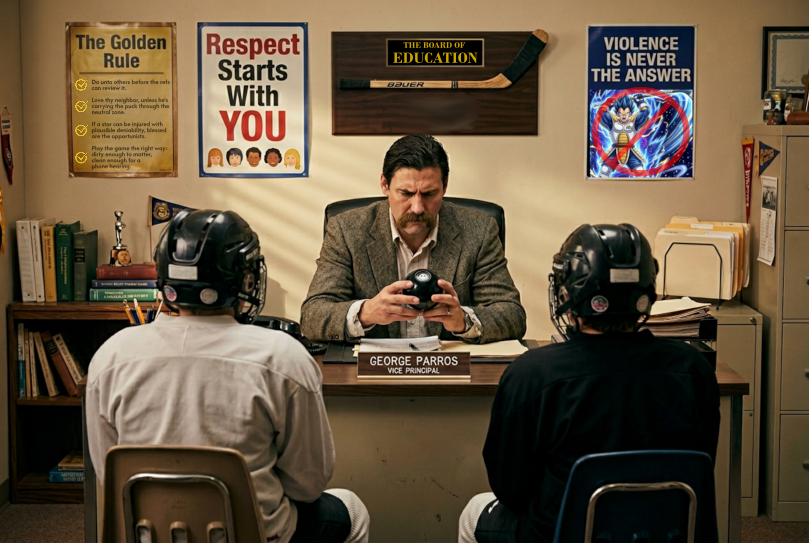
The NHL has achieved something remarkable: policy that doubles as a punchline.
It has taken the concept of justice, placed it on a conference call, and capped it at five games.
For those lucky enough not to have memorized the league’s disciplinary flowchart, a phone hearing is the procedural kiddie pool of NHL justice. If the Department of Player Safety offers one, the maximum suspension is five games. Not fifteen. Not “however many games are necessary to reflect the severity of the act.” Five. That’s the ceiling. That’s the whole menu. Congratulations, you have reached the part of the justice system sponsored by Nerf.
So when Radko Gudas rearranged Auston Matthews’ knee on a hit filthy enough to require its own defense attorney, the most important question was never going to be whether the league thought it was dirty. Of course it was dirty. Everyone with functioning corneas knew it was dirty. The question was whether the NHL would treat it like a genuine attack on one of the sport’s most valuable players, or whether it would retreat once again into its favorite bureaucratic panic room: procedure.
It chose procedure.
Matthews loses a season. Gudas gets five games. That is not discipline. That is an administrative love tap. And before somebody says, “Well, hockey is a violent sport,” yes. Thank you Captain Obvious. Hockey is violent. Football is violent. Rugby is violent. Life gets a little violent when you try to merge onto the 405. That is not the issue. The issue is that the NHL continues to shrug at the difference between physical play and reckless predation because their tool set is a Paint By Numbers book.
This is not hard. Justice demands proportionality -- let the fine match the crime.
If a player launches himself into a knee and blows up a superstar’s season, the punishment should not resemble the penalty for forgetting to return a library book.
It's infuriating that the NHL does not merely get these calls wrong. It gets them wrong in ways that suggest it has learned absolutely nothing from its own history. This isn't a new movie, it's a tired re-run. The Waterworld of NHL justice, if you will.
Back in 2021, Drew Doughty got his knee detonated by Jani Hakanpää on a play so obvious the officials on the ice correctly assessed a five-minute major and a game misconduct for intent to injure. Even in real time, amid the speed and chaos and usual NHL fog of stupidity, the refs knew what they were looking at. The Department of Player Safety then reviewed it and apparently decided the best course of action was to stare directly into the sun. No suspension. No added discipline. Nothing. Doughty missed eight weeks, came back diminished, and the league moved on as it always does—like a man stepping over his own house fire because the flames are technically in the hallway and not the kitchen.
This is the core issue with DoPS: not merely that it is lenient, but that it is wildly and insultingly inconsistent. Sometimes they get it right, which somehow makes it worse.
Raffi Torres got buried for a headshot. Ryan Hartman got ten games for driving a guy’s head into the ice. Matt Rempe recently found out that if you spend enough time treating the sport like a side quest in Grand Theft Auto, eventually the league will remember it has the power to suspend you for more than a long weekend.
So the NHL clearly possesses the theoretical ability to punish dangerous behavior with something more substantial than a sternly worded cough.
Which raises the obvious question: why does this department operate like a tired vice Principal consulting a Magic Eight Ball?
Headshot on Tuesday? Eight games.
Knee destruction on Thursday? Five.
Repeat offender? Shake hands and apologize.
Intent to injure? We're putting this in your permanent file, mister.
Career-altering outcome? Outlook uncertain; ask again after recess.
And yes, George Parros sits at the center of this circus, which remains one of the weirdest résumés-to-results disconnects in modern sports. On paper, he makes sense. Long NHL career. Enforcer. Princeton degree. Economics background. Never suspended. By all appearances, a guy who should understand both the culture of the sport and the difference between hard play and cheap-shot garbage.
In theory, he is exactly the kind of person you’d hire to run this office. In practice, the office still behaves like it was assembled by interns concerned with safe spaces and participation trophies.
At some point, you have to stop treating this like one smart guy failing to push the right buttons and start acknowledging what it actually is: a structural failure. A design failure. A league-and-union co-production in which everyone has collaborated to create a disciplinary process too procedural to be moral and too discretionary to be credible.
The phone hearing is the perfect symbol of all of it. Think about what an insane concept this is.
The league looks at a dangerous act. It decides, before the full hearing even occurs, that the upper bound of accountability will be five games because of the format in which the conversation takes place. Procedural clownery. That's like telling a defendant, “Good news, the court is handling this remotely, so the maximum penalty is now a frown and judgy eyes.”
The NHL is literally phoning in justice, and then acting wounded when fans notice the call quality is terrible.
And spare me the routine talking points about how these decisions are complex, how every play is different, how player safety exists in a gray area, how there are “many factors under consideration.” That language is what institutions use when they want the appearance of rigor without the burden of coherence. The current system is not nuanced. It is evasive. It is a vending machine that sometimes drops a suspension and sometimes eats your dollar.
The fix here is not subtle. Burn the whole damn thing to the foundation. Rebuild it around rules a partially functioning adult can understand. Build a rubric of reciprocity. A code of consequences. Algorithmic accountability.
Knee-on-knee with injury? Minimum ten games.
Repeat offender? Additive penalties.
Intent to injure? You’re gone until the injured player returns, and possibly longer.
Match penalty on the ice? Presumptive substantial suspension unless extraordinary evidence says otherwise.
Star player or fourth-liner? Irrelevant.
Mullet? Distressing, but not material.
And most importantly: publish the damned thing.
Let players know the cost before they commit the crime. Let coaches know what they’re risking when they send out some freezer-burned defenseman to play demolition derby. Let fans know that the logic exists somewhere outside a locked filing cabinet in Gary Bettman’s panic room.
There will be objections, because there are always objections whenever somebody proposes replacing discretionary nonsense with actual standards.
Some will say you cannot tie punishment too closely to injury outcome because outcomes involve luck. Fine. So does everything else in sports.
If a guy throws a cheap shot and the other player escapes with minor damage, the offender got lucky. Congratulations. That’s already built into the world. But the current system has overcorrected so far in the direction of abstraction that the consequences often bear no relationship whatsoever to the harm done. That is worse. Much worse.
The point is not to build a perfect machine. The point is to stop pretending the current one is anything other than a collapsing Jenga tower made of legalese and cowardice.
And what makes this especially galling is that the league loves to market safety when it costs nothing. Helmets became mandatory. Visors followed. You cannot remove your helmet during a fight now because apparently the NHL has concluded that if two grown men are going to punch each other in the face on skates, they shouldn't risk an OSHA violation too.
But while the league is applying eyeliner to a swine, actual on-ice cheap shots are derailing careers, warping seasons, and altering franchises. That is the lie at the heart of the Department of Player Safety. It is not protecting players. It is processing incidents. It can't find a line between competitive play and reckless endangerment, so it focuses on the bureaucratic busywork of after-incident reports. It's a traffic cop who's annoyed that an accident with injuries interrupted his Starbucks run. Indifference dressed up as procedure.
Hockey will always be violent. Good. It should be. Violence is part of the sport’s character. But there is a massive difference between the violence of competition and the stupidity of avoidable damage. Between legal punishment in the corners and reckless acts that take elite talent off the ice for months.
The NHL keeps pretending those things are difficult to separate. They aren’t.
The league isn't confused, it's unserious.
And until that changes, the Department of Player Safety will remain what it currently is: a beautifully named office dedicated to arriving late, speaking softly, and doing almost nothing that matters.

Torsten / 120 Proof Ball
Proof that the internet was a mistake.
