
Google Me Once, Shame On You
Doc Rivers and 3dfx illuminate how the market, the NBA and the Hall of Fame define value
In the span of eight days, Doc Rivers was welcomed into the Naismith Basketball Hall of Fame and also told he was no longer welcome in Milwaukee.
Doc tends to inspire strong opinions. Depending on the zip code, Doc is a championship coach, a chronic underachiever, a closer, a choker, a motivator, a politician, a stabilizer, or a well-tailored man with smooth delivery and a suspicious relationship with 3-1 leads.
Here’s the most Doc Rivers anecdote imaginable. Following a blowout loss to Chicago in March, reports surfaced that he gathered the Bucks and told them to look up his résumé. Google me, essentially. Price the asset off the brochure.
Which, in fairness, is an incredible way to tempt a columnist.
Fine, let’s evaluate the asset that is Doc Rivers, Head Coach. Value is something I think about constantly — trading stocks is my day job. One thing I’ve learned: Never get married to your positions. Have convictions, sure. But hold them lightly enough to recognize when the battlefield is no longer built for you to win.
To understand Doc, let me tell you about a company that had no trouble with conviction.
The Coronation of Scott Sellers
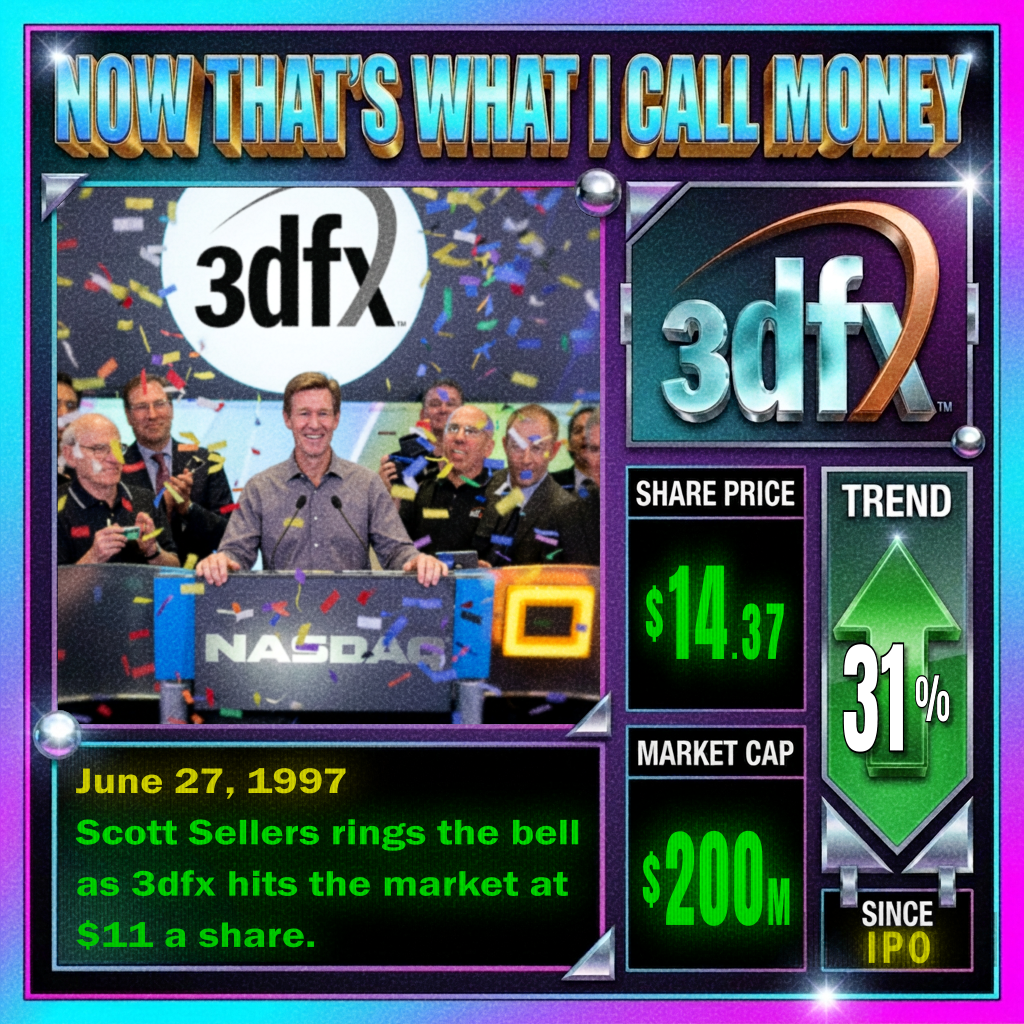
In 1997, 3dfx wasn't just leading the pack on PC video game graphics chips — they were the only ones who’d realized the race had started.
Their hotshot founders, including CEO Scott Sellers, had cut their teeth at Silicon Graphics — the company that had powered Jurassic Park, Toy Story and the Nintendo 64.
This wasn’t just a story about great potential either. 3dfx’s Voodoo1 card was the darling of the industry, three times faster than any competitor when it launched a year ago -- and its sequel was in development.
Real engineers. Real products. Real revenues. For investors, that might as well be blood in the water.
That’s an IPO at its sexiest, really: a coronation. A room full of adults agreeing that a story represents the future.
Orlando: Proof of Concept
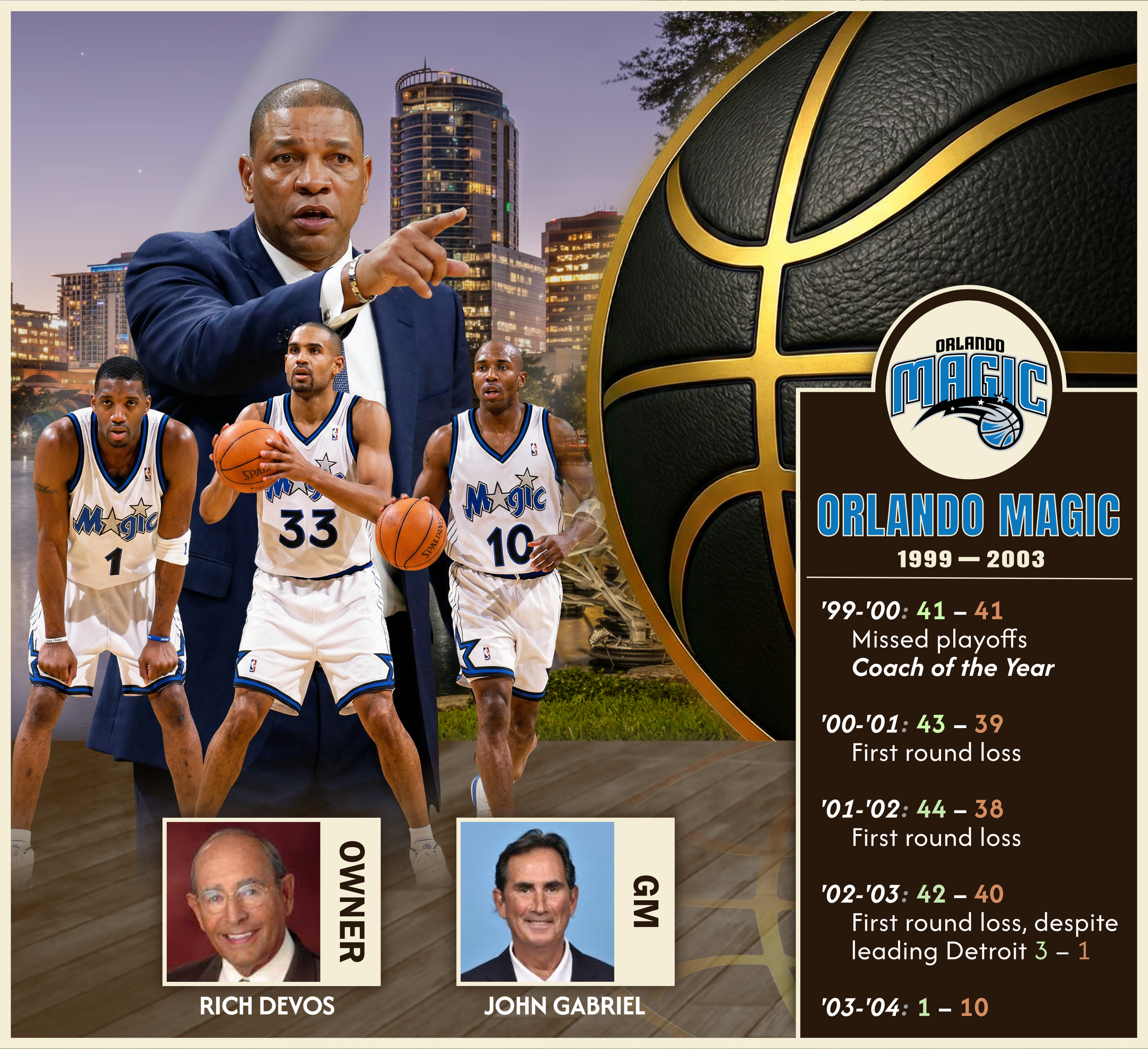
Tracy McGrady, Grant Hill, Darrell Armstrong
Doc Rivers arrived in 1999 with his own version of premium-market sheen: former All-Star point guard, command voice, television-ready polish, and the kind of calm facial expression that makes anxious owners think, finally, an adult who can use indoor voice during a crisis.
Doc used his time in the broadcasting booth to interview for a future coaching job, sounding smart about every team’s schemes without the burden of actually having to win games. So, he skipped the part where you grind it out as an assistant on somebody else’s coaching staff.
At the age of 37, Doc basically walked into Orlando Magic headquarters and explained why they couldn’t afford to hire anybody else. John Gabriel gave him the job, along with a roster of rookies and nobodies. Local papers panned the hire, calling him a rookie coach on a rookie team.
Then he won Coach of the Year in his first season.
Orlando went 41-41. Not exactly the kind of season that gets you a statue in front of your arena, but when your backcourt is Darrell Armstrong (6’1”), Chucky Atkins (5’11”), and Earl Boykins (5’5”), what team are you realistically stopping on defense? Look, the point is that they were expected to be the worst team in the league that year, that they’d tank for a chance to sign Tim Duncan in free agency.
Instead, they’re beating good teams, fans are buying tickets, and the arrow feels like it’s pointing up again. People knew their roles, somebody serious was in charge, and the whole operation no longer felt like a shopping cart with one bad wheel.
That first-season Doc value proposition reveals his true superpower: He could walk into a building and make different constituencies feel smarter for hiring him. He’d put each at ease by offering what they already wanted:
Ownership heard a coach who would protect premium assets and keep the building from looking unserious. The front office heard a man who wouldn’t pick ideological fights with the franchise player or say the wrong thing near a live microphone. Stars heard touches, spacing, cleaner looks, and a chance to watch their own value rise. Assistants heard something else entirely: come work for me, help me stabilize this thing, and I’ll help make sure the rest of the league knows your name when it’s time for the next opening.
He wasn’t offering tactical sorcery — he was selling alignment.
Over the summer, Orlando had cash to burn in free agency. But a fan of any small market team will tell you — that doesn’t matter much if nobody wants to sign with you. Who’d they pick up? Tracy McGrady, Grant Hill, and then…
Well, there’s that dinner. The night Orlando almost upgraded from the East Coast Clippers to the most terrifying thing east of the Mississippi. Tim Duncan is breaking bread with Doc and the team. He’s ready to leave the Alamo behind for Disney World. Someone from Tim’s camp asks the most basic superstar perk question in history: “Can the wives fly on the team plane?” Doc, fresh off a Coach of the Year trophy and smelling his own hype, says “No.” Just... no.
He basically told the greatest power forward in history that his wife could fly coach and like it. Duncan stayed in San Antonio, won four more rings, and, if only for an evening, Doc’s broadcast booth polish evaporated into a cloud of unforced hubris. But here’s the thing: you don’t even get to that dinner without the Doc making Orlando a destination for talent again.
Ultimately, it was a masterstroke of a season. That’s how legends start: a proof of concept so clean that everyone’s convinced they’ve found the grown-up version of magic.
Doubling Down on a Winning Hand
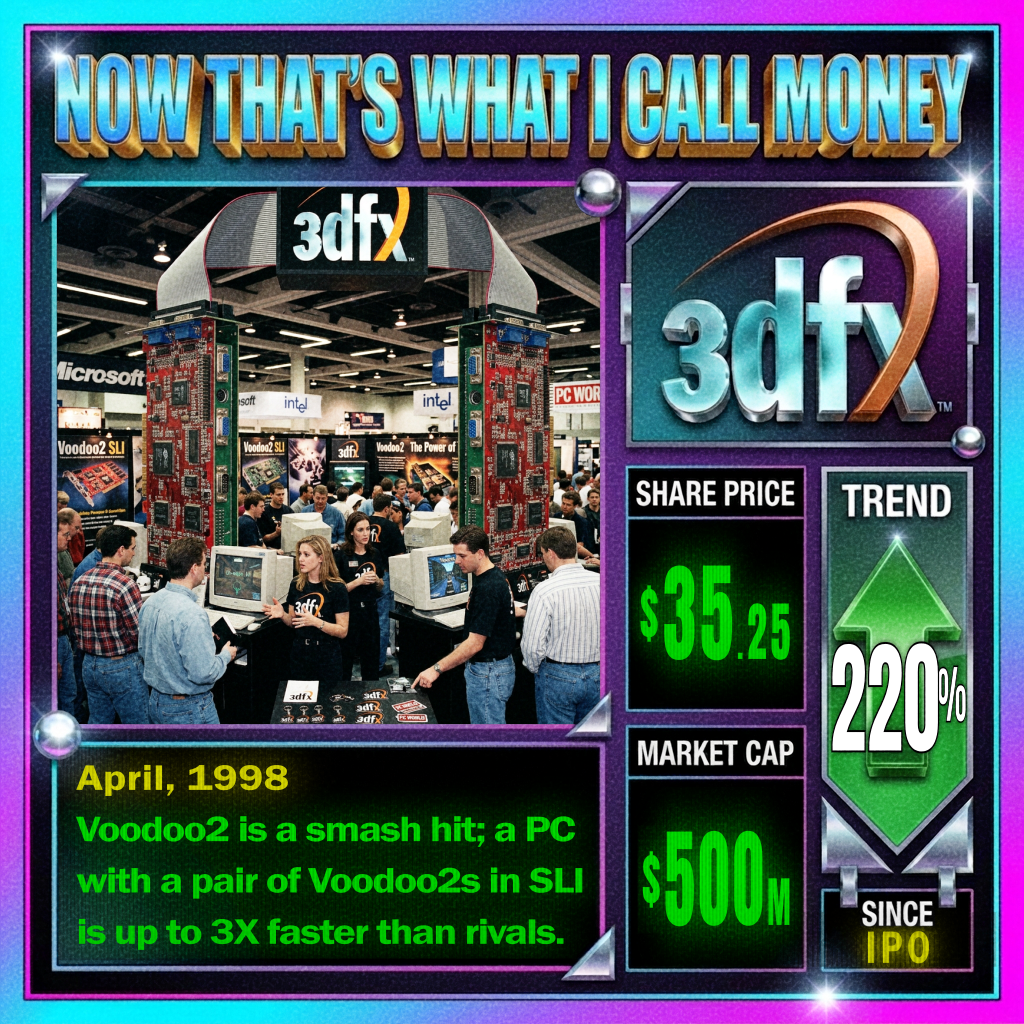
A seasoned trader knows to add to a position at a new high. Why buy higher? Winners often keep winning.
By the spring of 1998, Voodoo2 had arrived, kicking the door off its hinges. Revenue was up 861%, and 3dfx was profitable. Voodoo2 wasn’t just out in front, it was lapping the competition
One reason the benchmarks had become a full-blown comedy routine? 3dfx had unveiled their latest technological wizardry: SLI. The idea, at the time, was glorious in its stupidity. What’s better than owning one elite graphics card? Buying a pair, obviously. Just strap two Voodoo2s together like a tag team from the future sent to do two things: Render Duke Nukem 3D, and chew bubblegum. And they’re all outa’ gum.
If this all reads like swagger, that’s because it was swagger. It was like selling a man the fastest car on earth, then persuading him he was somehow still losing if he didn’t add a second engine in the trunk.
Boston: The Stars Align
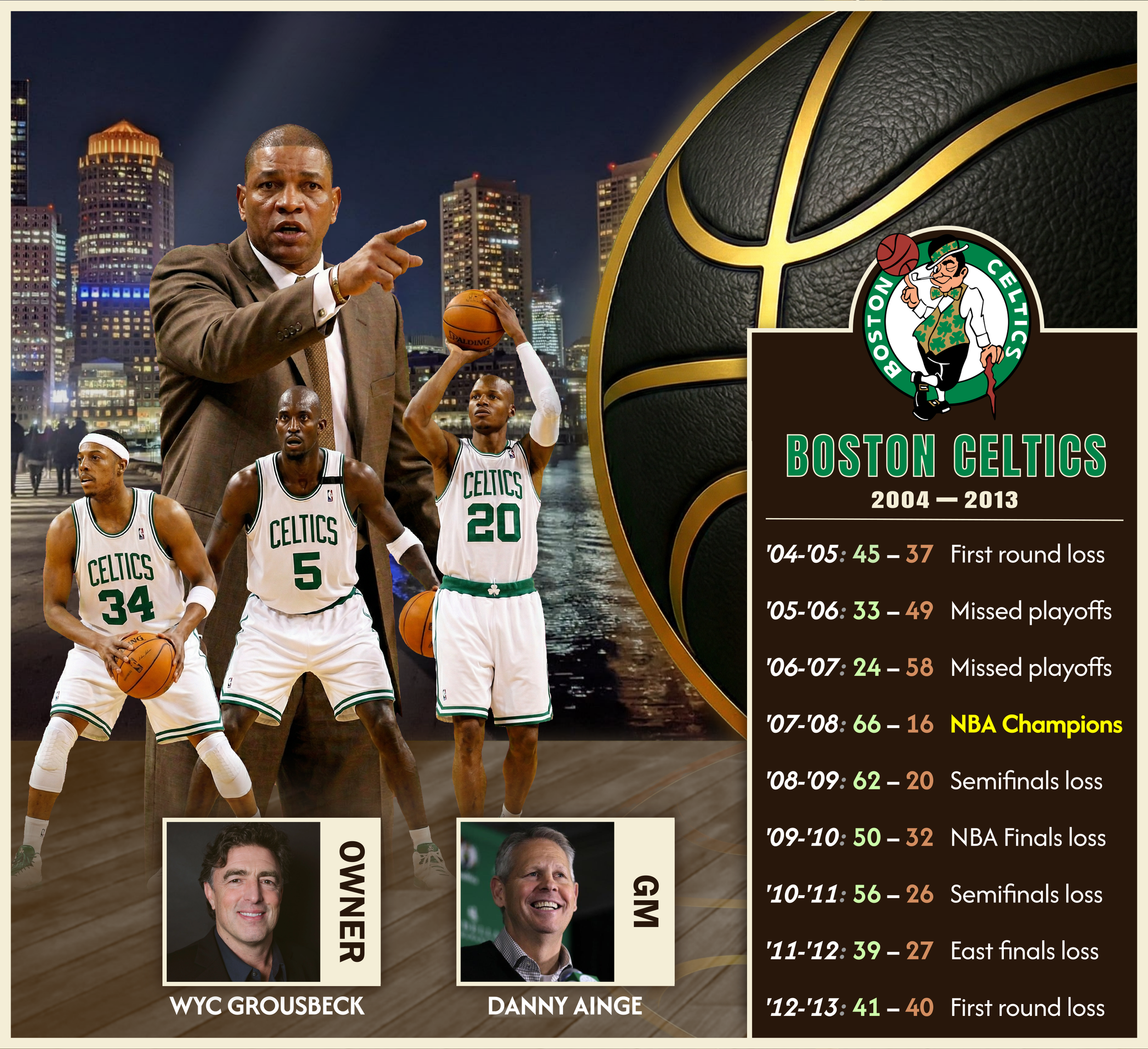
Paul Pierce, Kevin Garnett, Ray Allen
Orlando’s Heart and Hustle glow didn’t last long, sadly. Grant Hill’s seven-year deal had become a sunk cost on two bad knees. Tracy McGrady did his best to drag the franchise somewhere respectable, even pushing the top-seeded Pistons to a 3-1 lead in the first round before Detroit adjusted, and assigned Tayshaun Prince to T-Mac full time. Lacking a response, Doc became the first coach in NBA history to lose a series after leading 3-1.
The next year, Orlando started 1-10, and Doc was fired. Just like that, Doc was back in the broadcast booth at ABC, sounding smart about other people’s problems.
Boston did not hire Doc to take a super-team to the promised land. Danny Ainge hired him three years before Garnett and Allen ever showed up. At the time, the Celtics were a rebuilding franchise with one real star, one aging banner collection, and a strong institutional preference for acting like those two things were the same.
What Danny offered Doc was something timely: a chance to rehabilitate his image in public, without the pressure of contending for a title. Help restore credibility to a once-proud team, and set the table for the continued growth of Paul Pierce.
Ainge, spent the next few seasons stacking picks, young players, and optionality. In the mid-2000s, if you didn’t have a real answer for the Shaq-Kobe aftershock, the T-Mac/Yao experiment, or Detroit’s five-man suffocation chamber, then you knew exactly where you stood. The 2004 Celtics were not one move away; they were managing inventory.
Danny saw his shot in ‘07. A draft night 3-for-1 trade brought in Ray Allen. At the end of July, Ainge had his masterstroke, winning the Kevin Garnett sweepstakes in a 7-for-1 megadeal. This was the roster-construction version of SLI. What’s better than one star? Three of them, obviously. But only if they can be synchronized.
Doc understood that just because Danny Ainge backed the truck up to the Hall of Fame it was no sure thing that a stacked roster could win in July. It has to be organized, buy into a system. The day after KG signed, Rivers summoned Pierce, Garnett, and Allen to his apartment at eight in the morning, loaded them onto a private Duck Boat, and gave them a preview of June. This, he told them, is what we’re going to do at the end of the year, for our title parade. It was corny. It was theatrical. It was also exactly the kind of thing Doc is great at: giving powerful people a shared emotional picture before asking them to share a basketball.
He got real buy-in from stars who had each spent years being the center of their own basketball universe. Pierce and Garnett gave up some volume, but mostly in exchange for cleaner, more efficient work. Ray Allen gave up something costlier: authorship. He became the movement shooter, the spacer, the outlet pass; an overqualified role player. Rivers also deserves credit for two personnel decisions that fit his real gift. He landed Tom Thibodeau, giving the league’s best defensive obsessive an Associate Head Coach title, autonomy, and Kevin Garnett as a laboratory specimen. And he trusted Rajon Rondo early, choosing the turbulence and upside of a second-year point guard over the false comfort of some minimum-salary veteran with good posture and no burst.
The title itself was no parade route sketched in advance on that Duck Boat. Boston had to survive seven games against Atlanta, then seven more against LeBron’s Cavaliers, then six against a Detroit team that still felt stamped out of sheet metal and bad intentions. In the Finals, Game 4 in Los Angeles was the hinge. Lose that one and the Lakers seize daylight, home crowd, and narrative gravity all at once. Win it, and Boston takes the series back by the throat. They did. Rivers deserves real credit here: through four rounds of peak playoff pressure, he kept a newly assembled team calm enough to execute and connected enough not to come apart.
The 2007-’08 title run also became the season that made Doc’s value look portable in a way it probably never was. The Celtics stayed good. They made another Finals, nearly another one, and remained dangerous for the life of the Big Three era. But the deeper harmony of 2008 proved harder to sustain than the roster itself. Michael Jordan warned Ray Allen that role players stop loving their roles once the world starts telling them they deserve more, and Allen came to believe that was exactly what happened. Rondo wanted a bigger role, and so did Kendrick Perkins and Glen ‘Big Baby’ Davis. The point is not to refight every old Celtics grudge. The point is that 2008 uniquely demonstrated Doc’s strengths: four players in the Hall of Fame, a defensive mastermind to run the X’s and O’s, and a coach whose greatest gift was getting buy-in on a shared vision. Boston proved Doc could win a title. It also convinced the league, maybe too completely, that he had solved something universal.
High on Their Own Supply
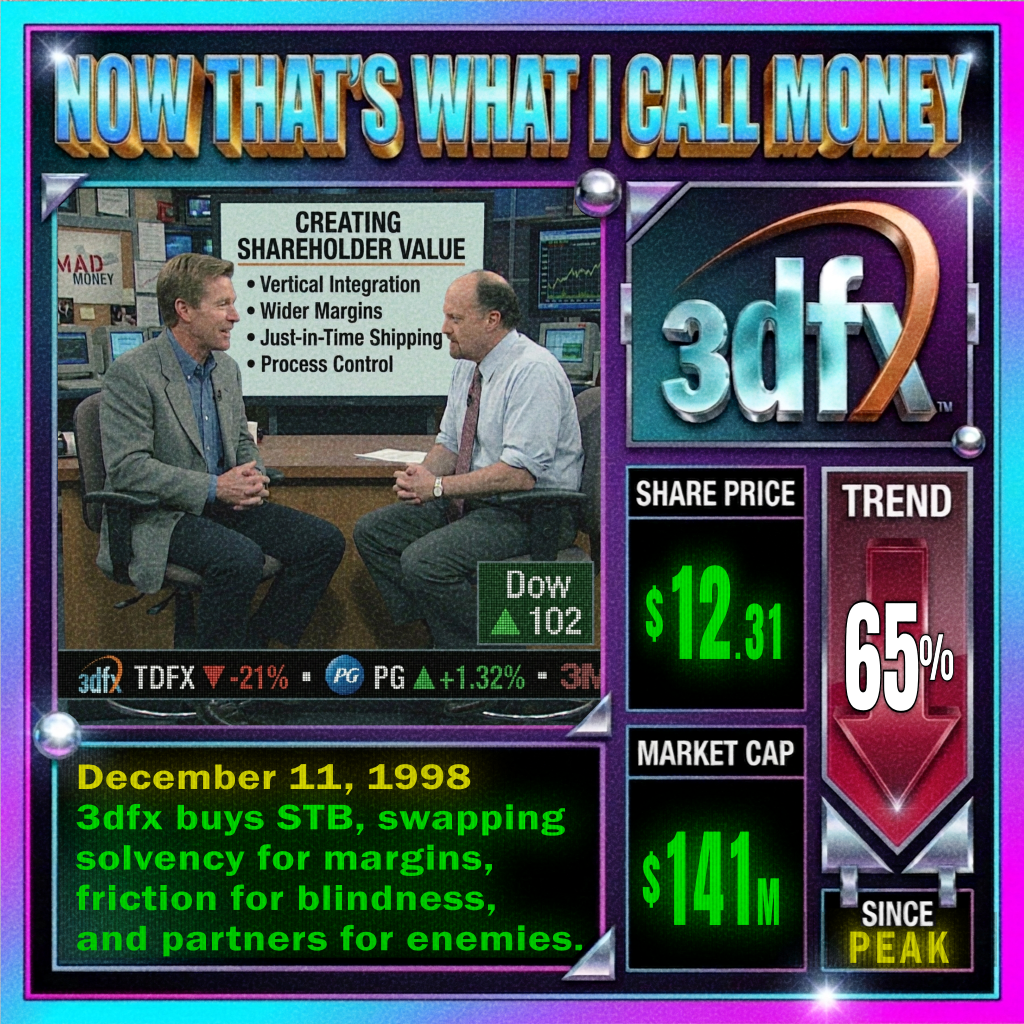
In late 1998, 3dfx was still out in front. Sure, nVidia's Riva TNT offered 32-bit color, but they were still behind on frame rate. Rather than extend their lead by investing in R&D to develop their next architecture, Scott Sellers decided that having partners with opinions was no longer tolerable.
3dfx announced it would acquire STB, a board maker that allowed them bring branding, assembly and distribution in-house. A manifest destiny fever dream of vertical integration. The pitch: Stop leaving money on the table and stop letting external partners dictate the pace. Voodoo is the star, so why not own the box office, the movie studio and the popcorn?
Before buying STB, 3dfx had designed their Voodoo chip and specs, and relied on a network of manufacturers to compete with each other on design, packaging, rebate programs and bundles. Diamond Multimedia, Creative Labs and such. Bringing manufacturing in-house converted them into competitors overnight.
3dfx traded a messy democracy for a quiet dictatorship, only to realize that an echo chamber is just a room where you can't hear the walls closing in.
Los Angeles: Centralized Power
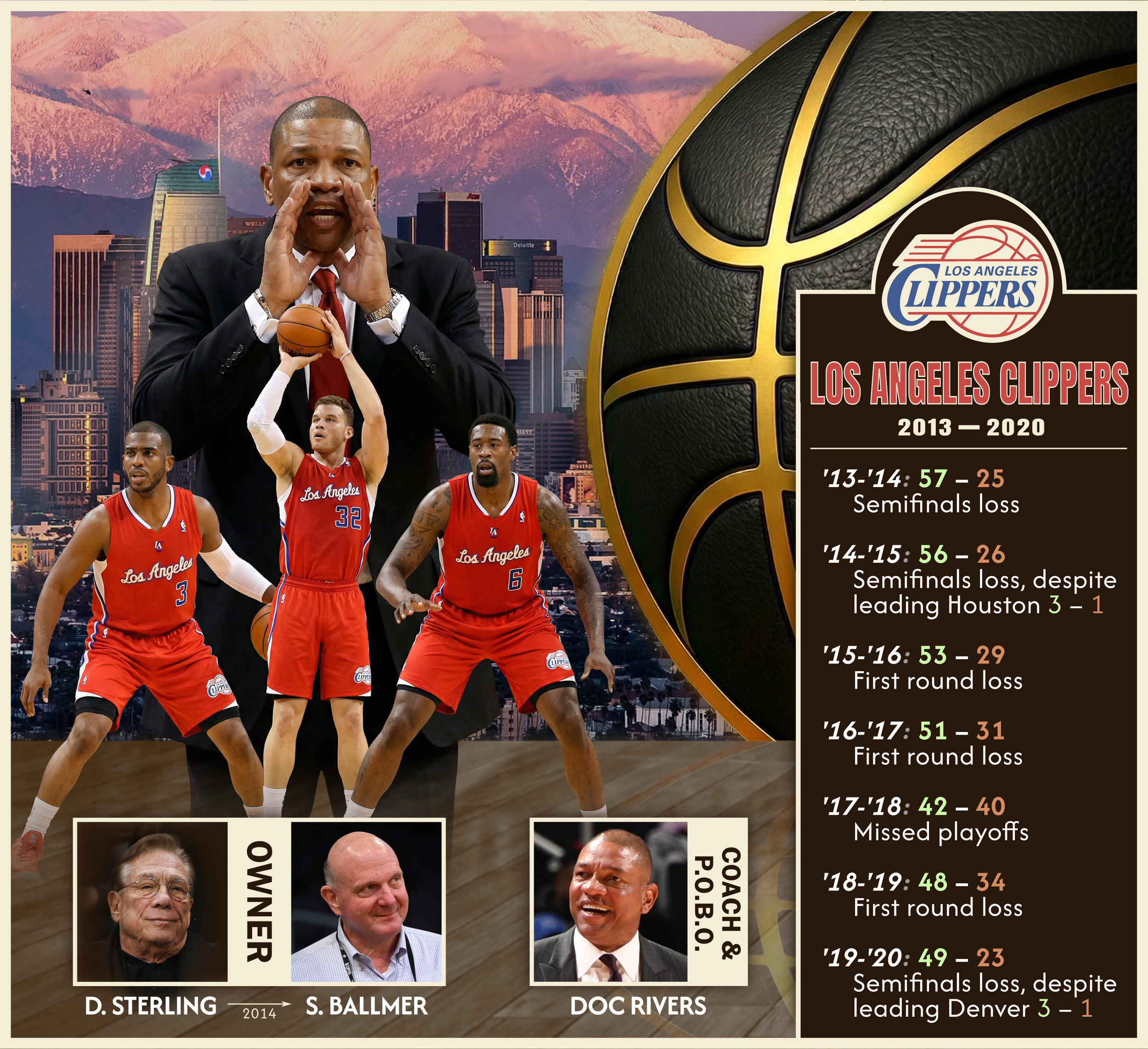
Chris Paul, Blake Griffin, DeAndre Jordan
If Boston was the clean-room version of the Doc Rivers thesis, Los Angeles was what happened when the league decided to scale the product.
The Clippers were a new, messier kind of challenge, and therefore more revealing: a volatile roster, a cursed franchise, and an owner so erratic that Doc Rivers nearly quit six days into the job.
That story matters. Before he had coached a game, Rivers thought he had finalized a sign-and-trade for J.J. Redick. Donald Sterling tried to blow it up after the fact. Rivers, furious that the Clippers would burn a free agent they had given their word to, quit. He woke the next morning to find that Sterling had signed off on the trade.
That’s the version of Doc that powerful people find irresistible — the man who enters the building ready to drag a clown operation into the modern world.
And when Donald Sterling’s racist comments surfaced in April of 2014, Doc was magnificent. That’s not charity, its true. The Clippers were in the middle of a playoff series against Golden State when their owner became a national disgrace in real time.
Suddenly Doc wasn’t managing rotations, boxing out Big Baby from the buffet, or arranging for a priest to bless DeAndre Jordan’s free throws. He was the public face of a morally bankrupt franchise, the shield between his players and the cameras, the man absorbing questions so Chris Paul and Blake Griffin did not have to answer for the bigotry of the billionaire signing their checks.
He helped hold the team together while they debated whether to boycott. He helped shape the symbolic protest. He kept the room from splintering in public while the organization burned around it. In the middle of the Sterling inferno, Doc was not cosmetic value. He was real value. The Clippers kept moving when they should have collapsed.
During the upheaval, the NBA installed an interim CEO who, to keep sponsors and players from defecting, promoted Doc Rivers to President of Basketball Operations. Technically, he was the GM’s boss. He was being asked to help run the institution, make personnel decisions, hire and fire staff. Total vertical integration.
And it wasn’t temporary; Steve Ballmer buys the team and signs Doc to a fresh five-year contract formalizing it.
The 2014-15 Clippers were the logical next step in the story. This was Lob City at full voltage: Chris Paul still barking directives like Napoleon with a crossover, Blake Griffin still hitting the show-and-go like a power forward with a forged passport, DeAndre Jordan blotting out the rim, J.J. Redick flying off screens, the whole operation carrying enough talent to make any sane person believe the breakthrough had finally arrived. They even got the kind of first-round win that is supposed to announce a contender, knocking out the defending champion Spurs in seven games on Chris Paul’s one-legged banker.
Then Houston happened. Up 3-1 in the second round, with a nineteen-point lead in Game 6 at home and James Harden on the bench, the Clippers did not just lose. They came unstitched. Corey Brewer turned into a flamethrower, the building tightened up, and Chris Paul on one good leg could not drag the thing back under control. By the time Game 7 arrived, the whole series felt pre-decided, like Houston was taking a victory lap on a video game it had already solved. The Clippers lost every quarter, at home, in the most-watched semifinal game in NBA history.
That’s the thing about Doc’s Clippers years. The regular seasons kept offering reasons to believe. May kept arriving with a crowbar.
The next season Blake Griffin broke his hand punching a staffer, which felt almost too on-brand for the era: talented, combustible, faintly absurd. Then came Portland and the double injury apocalypse, Chris Paul’s broken hand and Griffin’s quad tearing the title window off its hinges. In 2017 the Clippers won fifty-one games and still lost a Game 7 at home to Utah, which felt less like an upset than an obituary. The Lob City thesis was over.
Something always felt rotten about that era to me, though. And, we’ve learned more about it since.
Once Doc had unchecked power, his signature strength started mutating into politics. This is where Austin Rivers matters. Austin is a real NBA player, but the perception that Doc bent the organization around protecting his son landed poorly in a locker room already packed with ego, hierarchy, and championship anxiety. Chris Paul reportedly came to believe Doc cared more about keeping Austin than about improving the team, citing a trade that Doc reportedly nixed which would have sent Austin to New York and brought Carmelo Anthony to the Clippers.
And that gets to the deepest point of the Clippers section: Doc’s gift for alignment always carried a hidden tax. He was exceptional at telling different people the version of the story they needed in order to keep functioning. Owners heard order. Stars heard empowerment. Assistants heard opportunity. Veterans heard respect. But over time, that same talent can start to resemble something darker: placation. Triangulation. Customized narratives for every constituency in the building.
As Kevin Arnovitz later reported, several former Clippers described Rivers as a coach who would tell players what they wanted to hear, sometimes even validating one player’s frustrations about another, only for everybody to compare notes later. By the end, Doc was no longer just the man managing the Clippers’ dysfunction; he had become one of its recurring characters.
Once the same man controls the message, the shopping list, and the emotional thermostat, every flaw in the system starts getting explained away in his own voice. Los Angeles saw Rivers at his peak ambition, but it served to expose that his product always comes with an expiration date.
Philadelphia: Mean Reversion
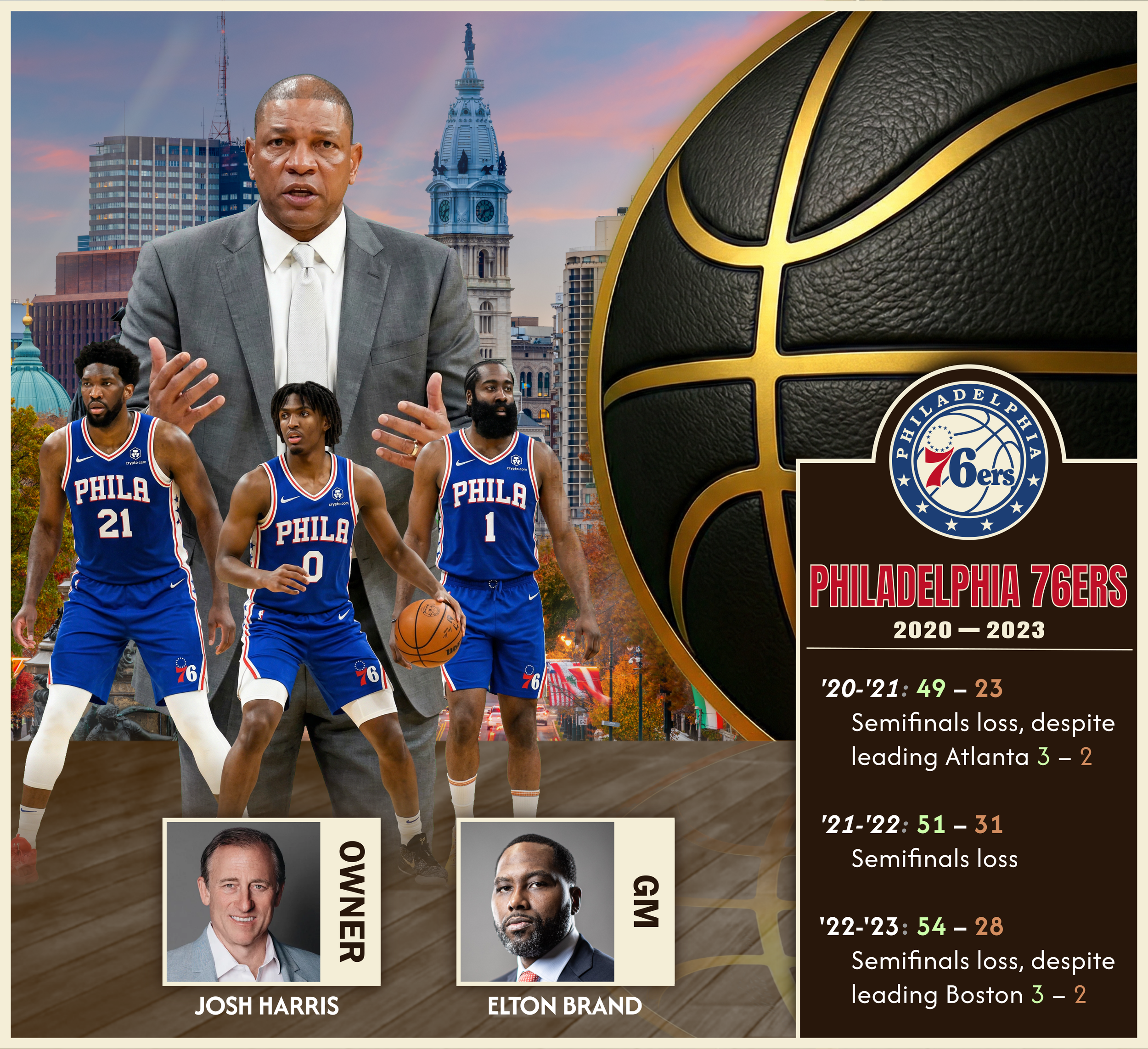
Joel Embiid, Tyrese Maxey, James Harden
When the Sixers announced the hiring of Doc Rivers as head coach, the Ringer’s Chris Ryan wrote, “Rivers will bring decades of NBA experience, a ring, and a reputation for getting through to players and getting them comfortable in their roles.”
The Sixers did not bring him in to invent some new geometry of basketball. They brought him in to make the building feel less insane. The previous regime had left behind enough institutional whiplash to justify almost any adult-looking intervention: the Al Horford fit had been disastrous, the spacing had curdled, the franchise still felt like it was recovering from a few too many years of “trust the process” being interpreted as “try literally anything.” What Philadelphia wanted from Doc was credibility.
Doc was able to deliver. The ‘20-’21 regular season looked for long stretches like the cleanest version of the Embiid-era Sixers. Seth Curry and Danny Green made spacing less theoretical. Dwight Howard offered six personal fouls, every game. Embiid looked like an MVP candidate.
Rivers had landed the Pacers’ Dan Burke on his staff over the summer, and his defensive sets saw the team improve from 8th to 2nd in defensive rating. The team finished the shortened season with 49 wins and the 1-seed, coasting past the Wizards in the first round with a gentleman’s sweep.
That is what made Atlanta so damaging. The Sixers were the one seed, had home court, had the best player, and still found itself looking helpless in front of a magnetic Trae Young who was shimmying before launching deep threes and shushing the crowd on the jog back. Ben Simmons’ confidence had begun to crater, making only 33% of his free throws in the series, and now he was getting hacked in the fourth quarter. There would be long stretches of all-bench line-ups that bled points. And then came the Simmons ending — the passed-up dunk, the entire city going feral, and Rivers, asked the question he absolutely did not want, responding that he did not know whether Ben Simmons could be the point guard on a championship team.
All year, Rivers had defended Simmons loudly, sometimes condescendingly, as if criticism itself were a sign that the public did not understand basketball. Then the series collapsed and suddenly Doc was no longer the player’s steward; he was the first man creating daylight between himself and the wreckage.
Simmons detonated into a holdout. Tyrese Maxey emerged as one of the few uncomplicated joys of the Doc years, growing from a nice young guard into something much more central. Harden arrived midseason as the latest expensive star handed over to the Rivers maintenance department. The Sixers won 51 games, then 54.
But playoff basketball kept asking Philadelphia harder questions than Rivers seemed interested in answering.
Against Miami in 2022, the offense repeatedly flattened into something procedural and stale. The Heat forced the kind of series that demands adaptation, experimentation, and a willingness to deviate from the laminated menu. Instead, Philadelphia kept looking like a team running through preapproved options. By the end of the series, even Embiid was talking like a player searching for something larger — toughness, identity, a cleaner sense of what the team was supposed to be when the game got hard.
And for a coach that was sold as a star-whisperer, he wasn’t having much luck connecting with the ones that mattered most. James Harden arrived praising Rivers as one of the best coaches ever. Cracks showed up soon enough. After a double-overtime loss to the Rockets in December Rivers called out Harden for taking the last three shots, who shouted back that Joel wasn’t open for a pass. ESPN would later report that Rivers called out Harden in a team meeting for traveling separately so he could stay for the nightlife following back-to-back losses to the Heat and Celtics.
And then came the final exam against the Celtics in the Semifinal. This was the series that should have rescued the Philadelphia chapter from all the old arguments. Embiid had won MVP. Harden was in the rarified air of averaging 21 points and 11 dishes. Maxey was the real deal, hustling like a greyhound on Red Bull. The Sixers stole Game 1 in Boston with Embiid sidelined, which was maybe the single best tactical moment of Rivers’ entire Philly tenure. Then they won Game 5 on the road and took a 3-2 lead back home with the conference finals sitting right there.
Game 6 at home was the whole Philadelphia experiment in miniature. Tatum had spent most of the night wandering around in a fog, missing 14 of his first 15 attempts. And still the Sixers tightened; the offense went rigid — nobody not named Joel or Tyrese could buy a bucket. Tatum woke up and started dropping knives into them. Afterward, Embiid pointed out that the Sixers had stopped doing what was working, which is about as close as he gets to walking up to the whiteboard with a red pen.
Game 7 dispensed with suspense entirely, as Tatum scored 51 and the Sixers lost by 24. It was another Rivers ending: a team with enough talent and experience looking decidedly solved by the other team when the series got tight.
Two days later, Philadelphia fired Doc. Reports indicate that Harden was instrumental in pushing him out the door.
The star whisperer lost the room on two of his three stars. The third never fully turned on him, but by the end even Embiid was diagnosing the same sickness: the offense stalled, the answers got stale, and the team kept freezing at the exact moment experience was supposed to matter most. And when the final exam came, all Doc’s twenty-four years of playoff experience bought him was front-row seat to Joe Mazzulla’s first-year breakthrough.
The Last Generation
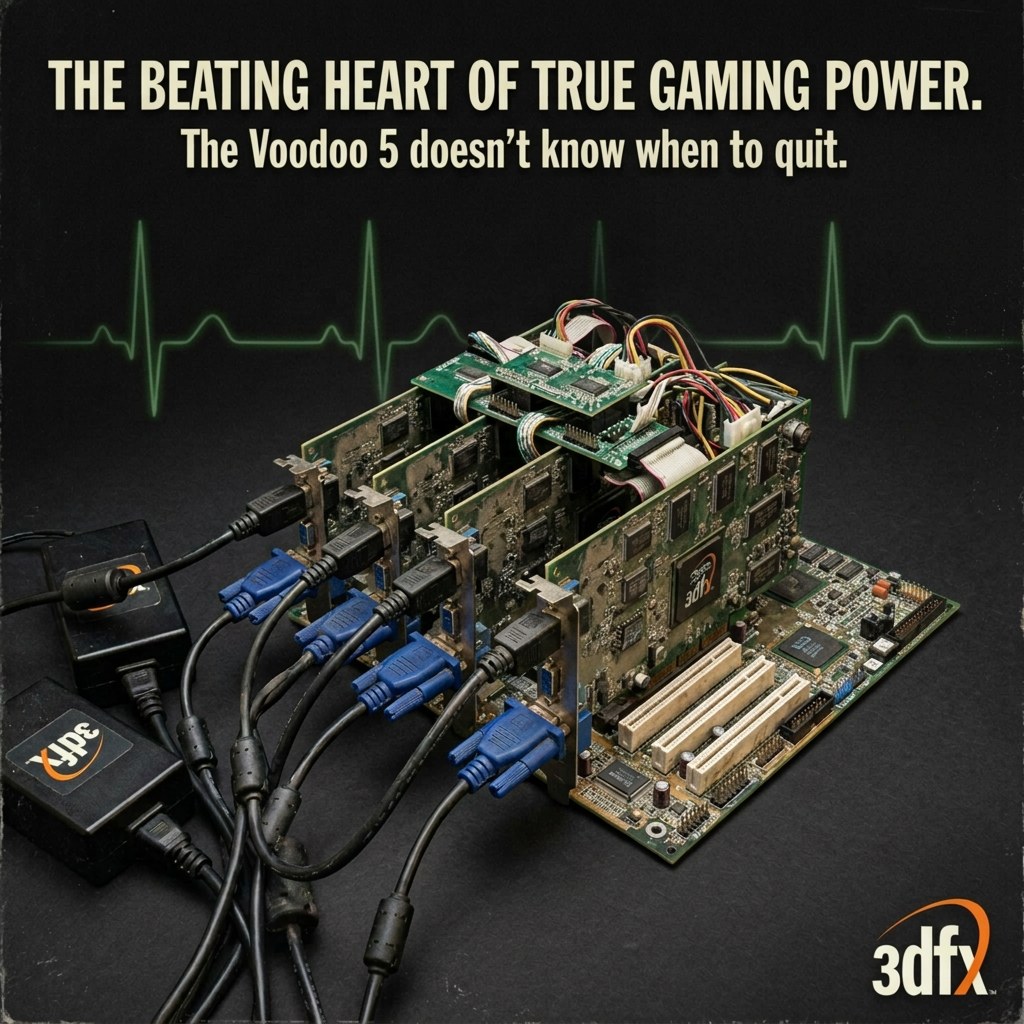
By the Voodoo3 era, Nvidia and ATI had already started framing 3dfx as yesterday’s news, hammering them for clinging to 16-bit output while the market embraced 32-bit color. 3dfx answered with swagger and a technicality: Voodoo3 still rendered internally at higher precision and then dithered the final image down, which let Scott Sellers and company insist it achieved 22-bit while running faster.
But that was the tell — they were now arguing that the old answer still counted, instead of defining the new one.
Voodoo4 and Voodoo5 showed up as their first 32-bit products, still leaning on SDRAM while rivals had jumped to DDR and hardware transform and lighting. 3dfx tried to bludgeon its way through the bottleneck by mounting two and even four chips on the same board. The brute-force solution was bulky, awkward, and no longer scaled gracefully; the Voodoo5 5500 needed a supplemental power brick.
Without a better answer, “just keep adding more Voodoo” was all they had left to sell.
Mark to Market
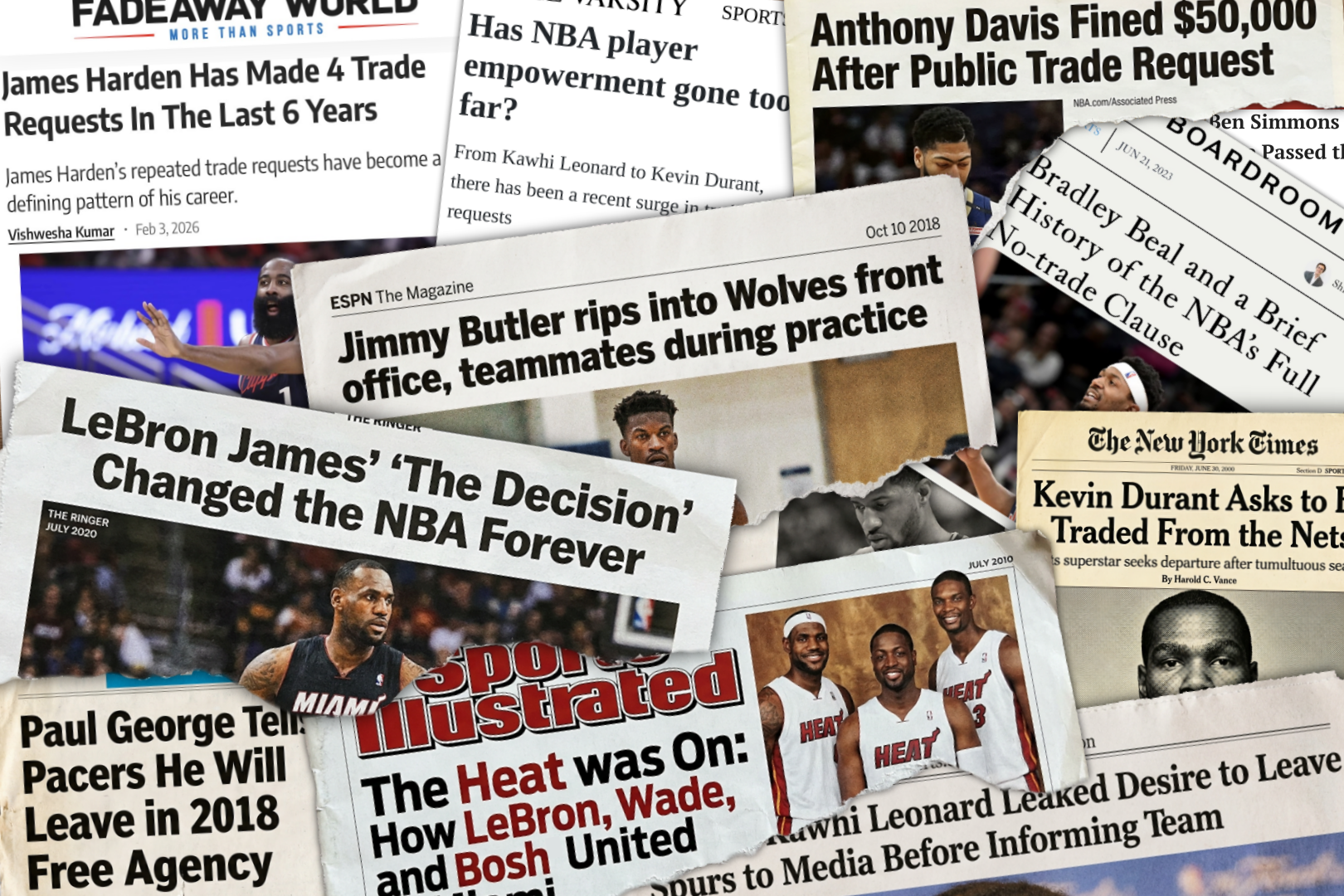
By now, the pattern is crystallizing. At multiple stops, belief in Doc Rivers breaks the same way: suddenly. A playoff series tightens and the answers come back looking familiar, worn. A star goes cold on the message. The locker room stops buying before the institution does.
This is the market inefficiency at the center of Doc Rivers. When you’re not selling tactical wizardry so much as consensus on a shared vision, your value is tied to something different than the win-loss column. It’s tied to presenting a picture of competency, stability, and alignment.
The shared consensus he builds really does seem to have honeymoon-period benefits. First seasons with Doc often beat expectations. He tends to arrive with a strong staff, fresh authority, and a room newly willing to believe in structure. But when the players stop listening, or start comparing notes, or simply stare too long at the same playoff endings, Doc’s value reaches its expiration date — and his employer pays him to go away.
So why does he keep getting hired anyway?
Simple. The thing he does best has only grown more valuable since he began coaching in 1999.
Modern stars do not just score points and sell jerseys. They trade in leverage. They pressure front offices through trade demands, free-agency choreography, leaks, no-trade clauses, strategic silence, and the occasional public mood swing disguised as “just being honest.” Teams are no longer simply managing talent. They are managing coalitions, each one unstable in its own expensive way. In that environment, a coach who can walk into the room sounding like order still has a market.
Maybe it doesn’t last five years. Maybe it only lasts two or three. But to a nervous owner who thinks his franchise can still break through if his stars just stay in town a little longer, that’s worth paying for.
When Doc makes a building feel less combustible and creates the impression that the adults are back in charge, he’s selling time. When he can make stars feel heard right up until they no longer do, he’s building a runway. He can keep the thing from flying apart in public for longer than a lot of coaches can.
In the player empowerment era, that has value. Real value. The kind that still commands a premium. It just doesn’t always have the same value as a championship coach in the final two weeks of May.
Doc Rivers may never have been the cleanest answer to the basketball problems in front of him. But to anxious institutions staring at a room full of stars, agents, and ambient grievance… he looks like hope.
Capitulation
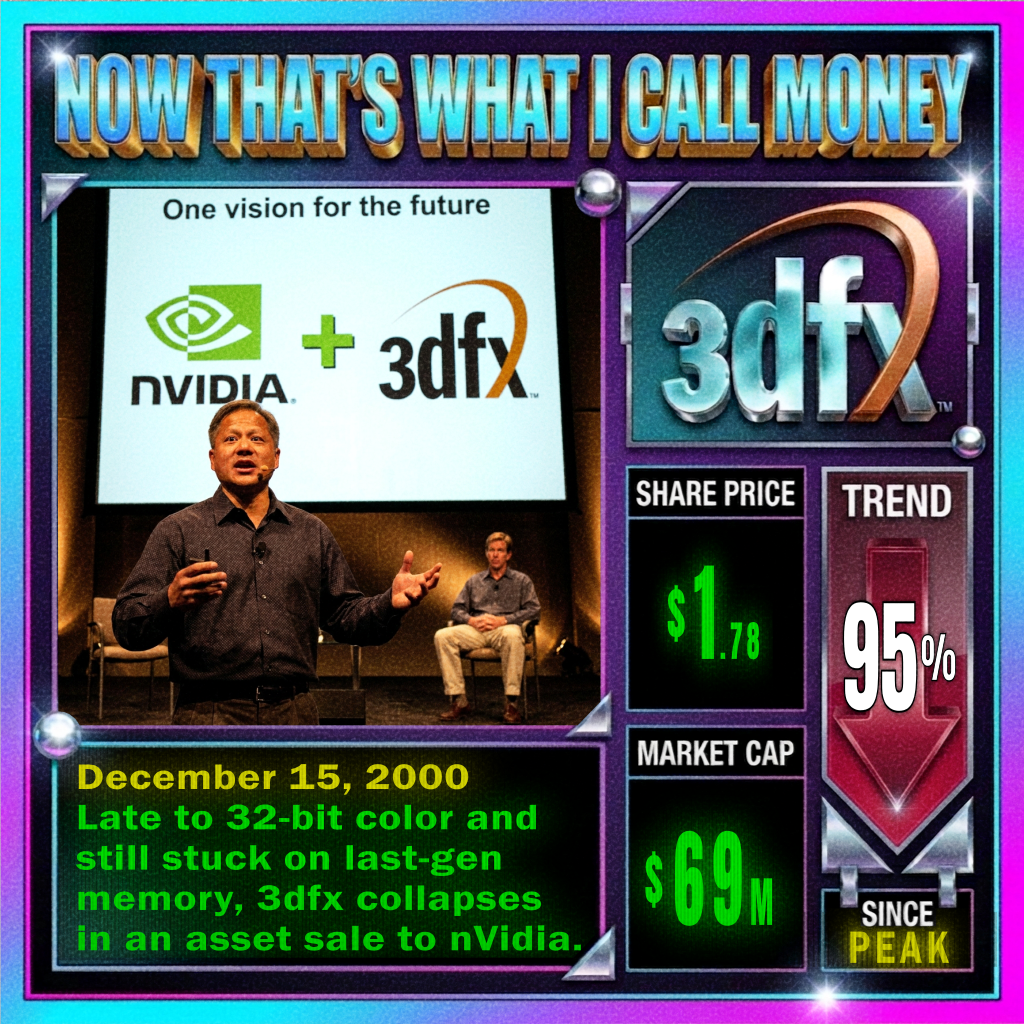
That’s the thing about belief-based systems: they can hold surprising value for a long time, right up until they can’t, and then the markdown arrives all at once.
They had run out of excuses by then. First came the oldest corporate sin: getting comfortable while ahead, mistaking a lead for a moat. Then came the dumber one — spending precious time, money, and energy fighting their own partner network instead of the companies actually trying to beat them.
Once those partners were gone, so was the dissent that might have forced fresh ideas into the room, and 3dfx arrived late to the features that were already redefining the market.
By then, rivals were no longer just catching up; they were solving 3dfx itself, building around its limits and attacking the assumptions it kept dragging forward from one cycle to the next. That is how stagnation compounds: first the old answer loses its edge, then it becomes the weakness everyone else designs for.
Milwaukee: The Buck Stops Elsewhere
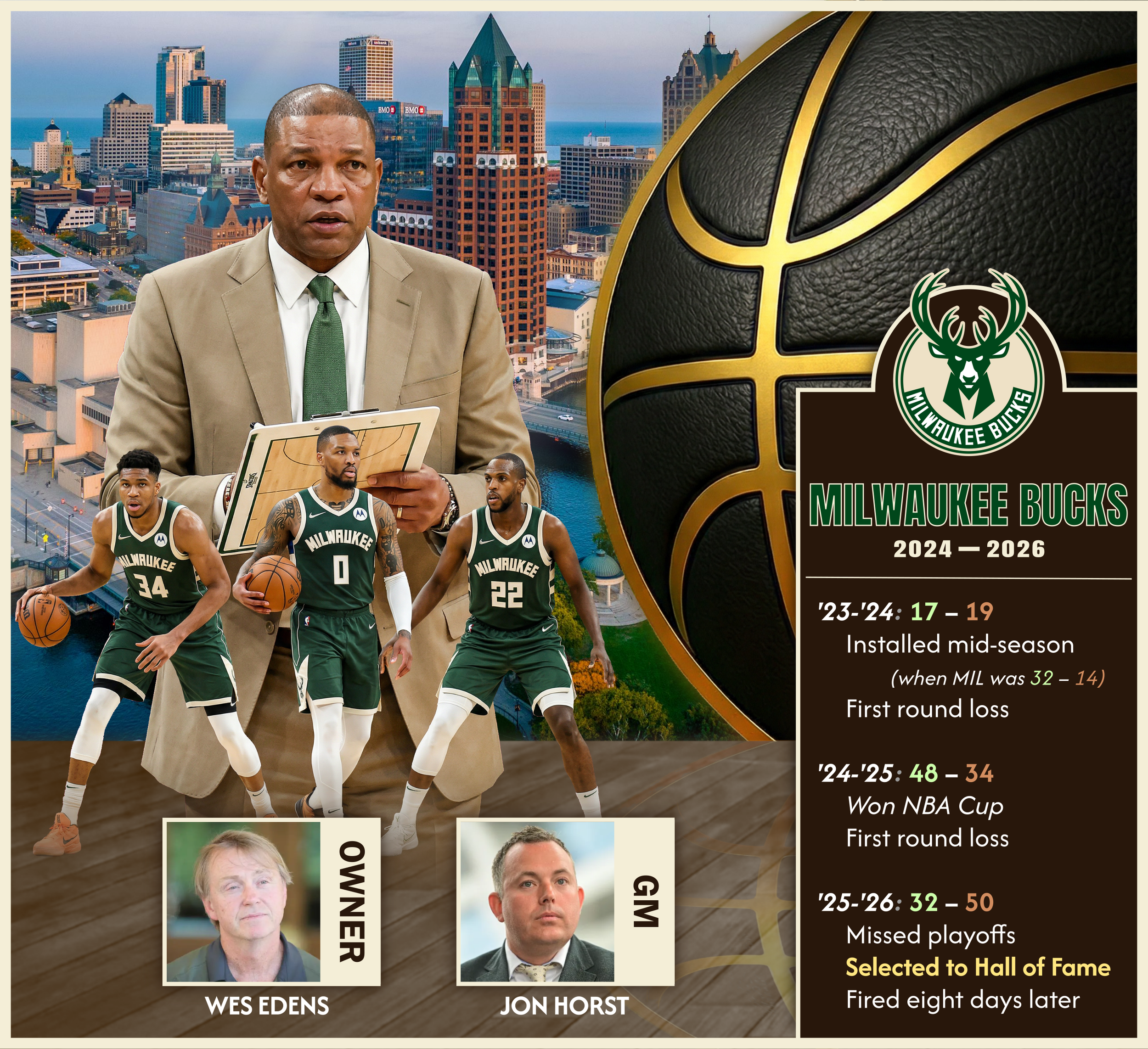
Giannis Antetokounmpo, Damian Lillard, Khris Middleton
Milwaukee was a crisis that appeared tailor-made for Doc Rivers. Adrian Griffin had gone 30-13, but the defense had cratered and the vibes were toxic. So the Bucks did what nervous contenders do: they paid up for a stabilizer. Rivers arrived on a four-year, $40 million deal to turn a solid start into a real championship run. Instead, Milwaukee went 17-19 the rest of the way and lost in the first round to Indiana.
But the blame shouldn’t be on him, Doc insisted while managing expectations in January. "I've never done this,” he said, referring to taking over mid-season and not getting a training camp. “I wouldn't wish this on anyone. It's going to be a challenge."
After an embarrassing loss to a depleted Memphis team, he took a direct shot at his own players — “We had some guys here, we had some guys in Cabo.”
And if Milwaukee was supposed to be a fresh start for Damian Lillard, Rivers never really made it feel like one. The odds were stacked against Doc on arrival. Dame had been ripped out of Portland at the end of a summer of trade limbo, dropped into a Giannis-first ecosystem, and asked to become both a co-star and a quick fix. Dame admitted online that he didn’t really have a life in Milwaukee and appeared homesick. What Rivers offered was not exactly warmth. He publicly discussed Lillard’s conditioning, repeated the story that Dame told him he had entered camp in the worst shape of his life, and never seemed able to turn the partnership into something more natural than an expensive workaround.
When Lillard’s Achilles tore and the Milwaukee experiment finally collapsed, the ending felt brutally efficient: injury, exit, and then a quick return to Portland. Fair or not, it made the whole Bucks detour look less like a second home than a long layover.
Then came Giannis. In 2026, as the season curdled into a 32-50 collapse, Rivers found himself in the middle of a public cold war over Giannis’ health, availability, and the organization’s willingness to keep him sidelined. Giannis wanted to play. The Bucks wanted to not risk his health with nothing to gain, and also a nice lottery pick. Rivers’ answer was pure Doc: “This is a grown man’s game,” he said, calling attention to how publicly this feud was being waged. And then, “coaches don’t decide any of this.” That’s the move. Stand in front of the fire as the adult in the room, then insist you couldn’t possibly be involved.
It got worse. Rivers publicly mused that Joel Embiid was the most talented player he had ever coached, which landed in Milwaukee about as softly as a bowling ball through a windshield.
On March 2, the Bucks were eight games below .500. During a player disagreement before a game against the Celtics, Doc went full cringe. “Look at my resume and Google me,” Rivers said to the Bucks. “I took teams to the playoffs and championship that weren’t supposed to be there. I thought this was one of them.” It is unclear how many players were inspired by googling what Garnett, Pierce, and Ray Allen did nineteen years earlier, but Boston sat both Jayson Tatum and Jaylen Brown that night anyway. Milwaukee lost by 27.
And that, finally, is the accountability problem with Doc Rivers. He demands it constantly from players — on defense, on effort, on focus, on role acceptance, on loyalty. But when accountability starts circling back toward him, the language changes. It becomes injuries, roster construction, front-office decisions, bad timing, player availability — anything but the man standing at the whiteboard.
Doc Rivers was once asked in an interview how he deals with the criticism around all of his 3-1 losses. He explained that in 2015 with Lob City, “… Chris Paul was running on one leg and we were also the underdog in that series. When you think about it, Houston had home court, not us. No one tells a real story. And I’m fine with that. It’s unfair in some ways. I don’t get enough credit for getting the three wins. I get credit for losing.”
There’s only one head coach in the NBA who can soil the mattress and then ask you to thank him for it. Even Doc’s failures come with an invoice.
At the exact moment Rivers was fighting public friction with Giannis, fielding job-security rumors, and presiding over a Bucks season that felt, by multiple reports, like a funeral, the Naismith Memorial Hall of Fame decided it was time to honor Doc forever, at a selection ceremony held at the NCAA Tournament in Indianapolis. That is the absurdity of Doc Rivers in one frame: a coach whose present-tense authority was visibly eroding, whose relationship with his franchise player had become its own running subplot, and whose team was busy auditioning for the lottery, all while the institution stepped forward to assure us that history had already rendered its verdict.
If this piece has a thesis, Indianapolis was the thesis posing for photos with Candace Parker and Amar’e Stoudemire.
Liquidation
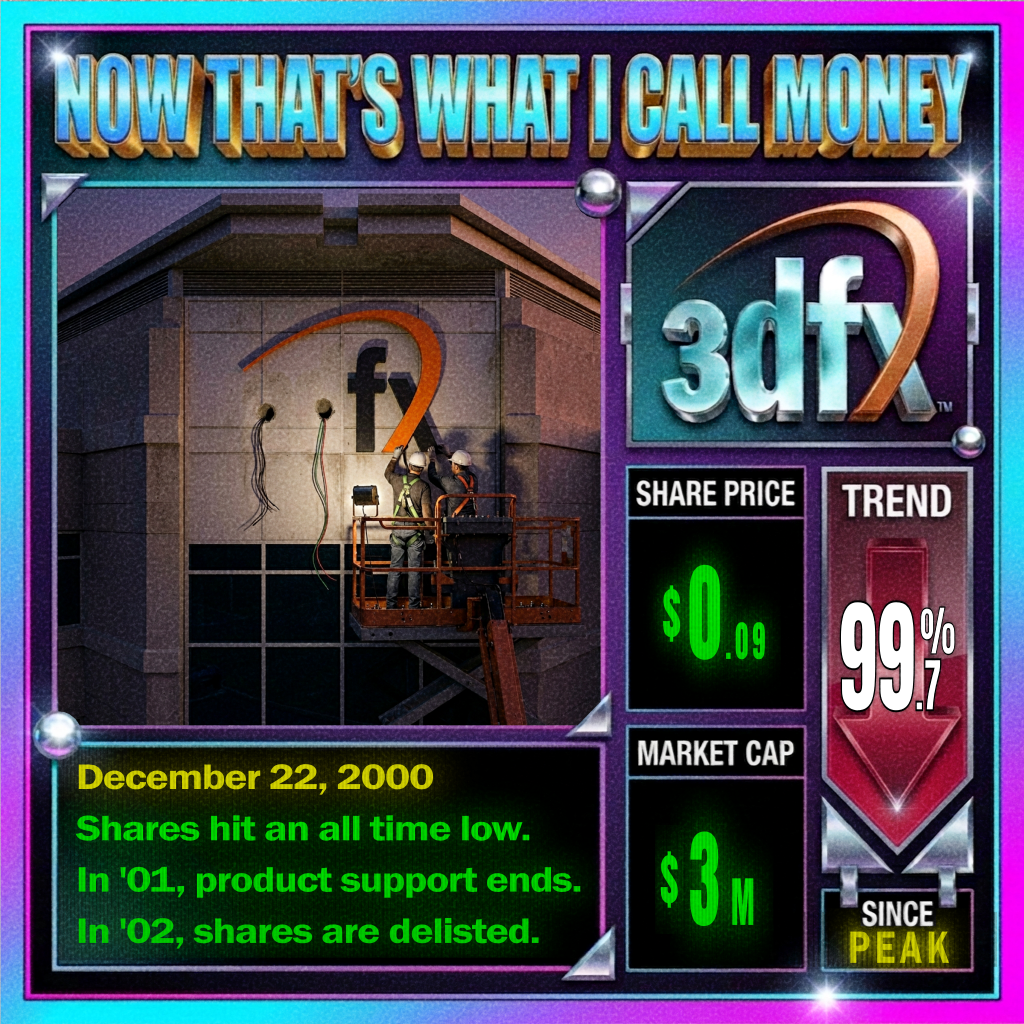
A few days after nVidia bought 3dfx’s prized assets, the market finished the job. Shares collapsed to nine cents — not even worth the paper the certificates were printed on. That's the part of failure people remember, because public humiliation has a way of clarifying the truth.
The rest was just legal housekeeping. The lawyers arrived to argue over the wreckage in bankruptcy court.
Whatever 3dfx had once meant to gamers, engineers, or believers no longer mattered. It wasn't a product anymore, just a cautionary tale about failure, improvidence, and hubris.
And at the very bottom of it, Scott Sellers was still there, holding nearly all his shares — a peak paper fortune of nearly $100M reduced to ash. At nine cents a share, it is hard to tell where conviction ends and atonement begins. What matters is that he stayed.
Selling the House Short
Scott Sellers got the full public-market ending. The stock ran, the story broke, the partners turned to enemies, the product got lapped, and eventually the shares hit nine cents. Whatever conviction he had left by then was no longer an executive philosophy. It was atonement. He stayed long enough to wear the wreckage.
Doc Rivers has never faced a nine-cent reckoning.
From Boston on, Doc has understood something Scott Sellers never really did. In a belief business, one great victory can be refinanced for years. The 2008 title did not just validate Doc Rivers. It securitized him.
Since then, he has moved through the league less like a coach being freshly priced on current basketball results and more like a prestige asset whose last clean audit keeps getting photocopied and reattached to the next offering memorandum. Boston won him the One Ring. The One Ring won him the rest of the contracts.
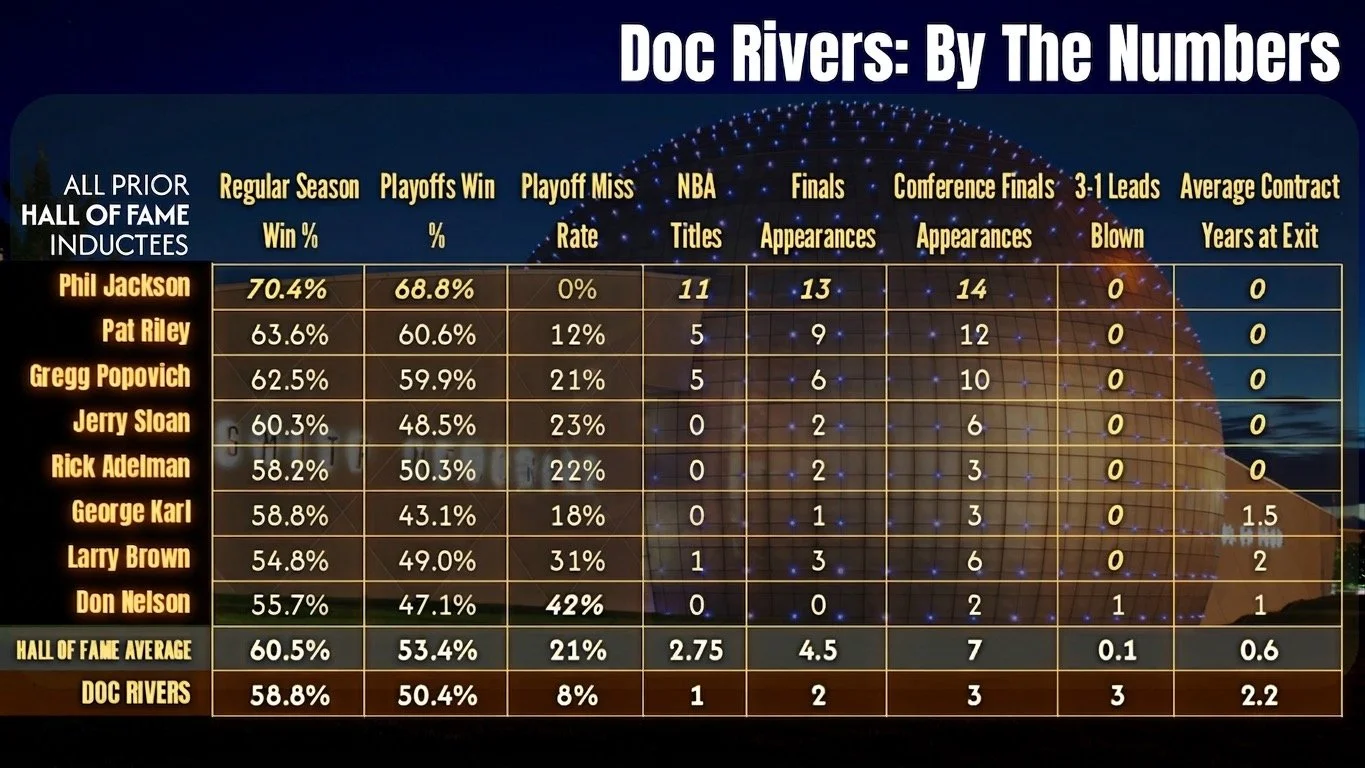
And those contracts do not behave like the contracts of his Hall of Fame peers. That is where the numbers stop being decoration and start becoming the whole indictment. The average Hall of Fame coach exits with just 0.6 years left on his deal. Doc exits with his employer on the hook for an average of 2.2 years of salary. That is not normal turnover. That is golden parachute after golden parachute. The league does not merely hire Doc Rivers. It commits to him at a premium, discovers on a delay that the product has a shorter shelf life than the term sheet, and then pays to unwind the position. Again. And again. And again.
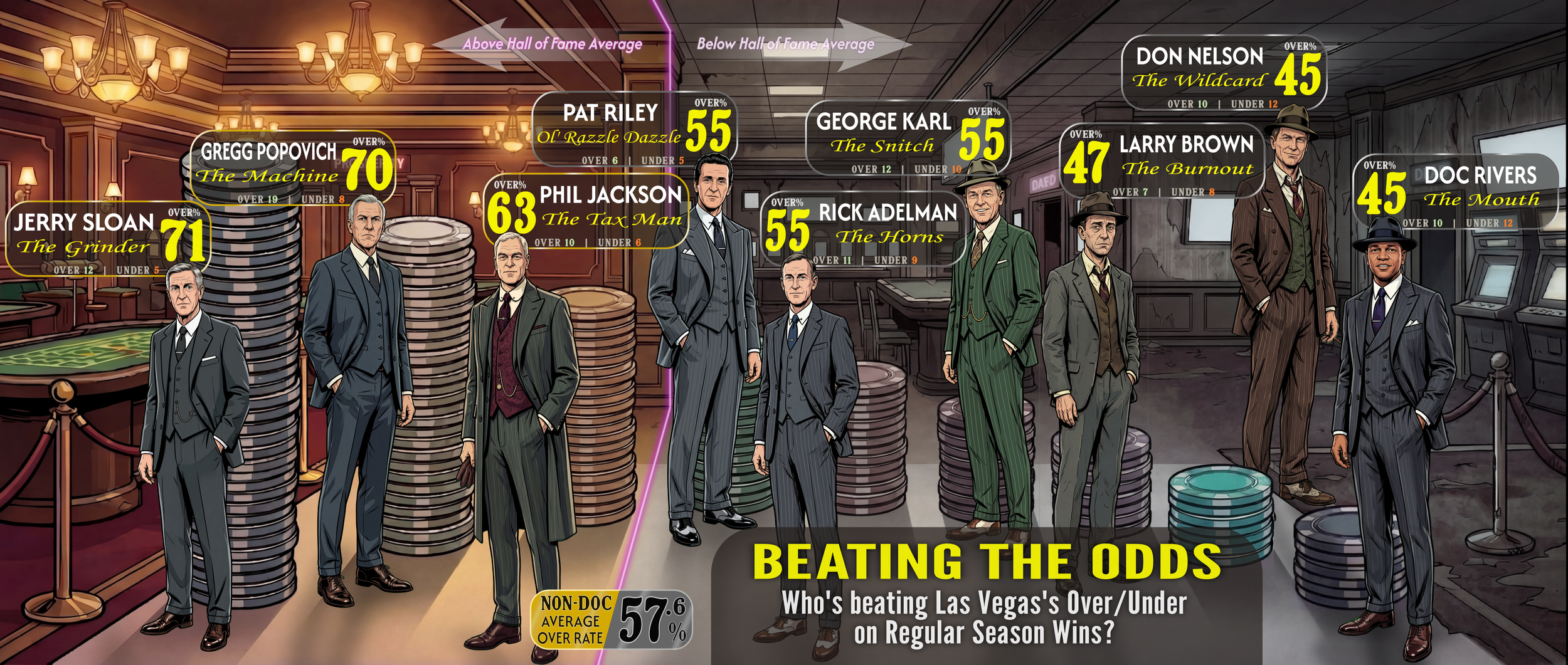
Even his regular-season reputation wilts under a little fluorescent light. The public story says Doc is a stabilizer, a floor-raiser, a man who at least gets you safely to respectable. But the over-under record tells a nastier truth. Against Vegas expectations, Doc is not some machine of dependable excess. He is 10-12 on full tracked seasons, an over rate of 45%, tied more closely to volatility merchants like Don Nelson than to the steady Hall of Fame standard of 57.6% set by everybody else. The “safe veteran hand” keeps showing up priced like a luxury vehicle and finishing like something a tier below. He is not a regular-season cheat code. At best, he’s a first-year sugar high. The honeymoon often goes well. Then people start trying to cash the checks his mouth has been writing since media day.
And we already know where the shelf life runs out.
In Philadelphia, we saw that he was not really a star whisperer, at least not in the durable sense that phrase implies. The stars that mattered most did not leave sounding understood. They left sounding exhausted, alienated, or eager for a different voice. In Los Angeles, we saw that his gift for consensus building came with a preset expiration date. Once alignment curdled into triangulation, once every constituency started hearing its own custom bedtime story, the whole thing stopped feeling like leadership and started feeling like politics. In Milwaukee, the last veil dropped. You cannot present yourself as the adult in the room while ducking the accountability that adulthood requires. A leader sets the example before he cites the résumé.
So no, Doc never got the Scott Sellers ending. No nine-cent humiliation. No ash-heap reckoning. No long public sit with the consequences of overstaying the old answer. He has been too realistic for that. He understood that the point was never to die with the shares. He hedged accordingly.
That does not make him a fraud. It makes him something more interesting, and maybe more useful to understand clearly at the end of all this: a coach whose truest elite skill has always been selling institutions a version of themselves they prefer to believe. When that skill is paired with fresh authority, a good staff, and players still willing to buy in, the results can be real. Sometimes even banner-real. But the clock starts immediately.
Final Valuation
It would be too easy to say Doc Rivers succeeded because the league is stupid. The league is not stupid. It is just governed by incentives that are often more human than tactical.
Doc is not some fraud who wandered into forty years of basketball by accident. He knows the game. He’s been calling sets, managing egos, reading matchups, and living inside the geometry of the sport since before some of his players were born. The point is not that Doc knows nothing about X’s and O’s. The point is that in the modern NBA, the edge created by superior scheme is often smaller than the edge created by superior access — access to stars, access to buy-in, access to a little more health, a little more patience, a little more runway before the whole thing flies apart.
That is the real currency of the league. Not chalkboard brilliance in the abstract, but that fragile nexus of athletic ability, skill, and health that turns a roster into a window. Those windows are short. They are expensive. They make owners nervous. And nervous owners do not always hire the best basketball theorist. They hire the man who sounds most likely to keep the asset from detonating in public.
That is where Doc has always had real value. He sells himself as an obstacle clearer. Not the source of the stars’ talent, not the author of the franchise’s vision, but the adult who can walk into a room full of money, ambition, insecurity, and grievance and get everybody to keep rowing in the same direction for a while. That coalition-building skill is real. It has won games. It has probably preserved windows that would have shattered sooner under a lesser political operator.
But it comes with a catch. Doc’s genius has always been aspirational. He knows how to appeal to the self-interest of others because he is fluent in self-interest himself. He understands ambition at a molecular level. In the right hands, an owner can use that. There is alignment, at least for a time, when the coach wants to shine by making your stars function. The problem comes later, when the room realizes that the alignment was never culture. It was a deal.
And Doc is especially dangerous in organizations where ownership mistakes polish for depth. If he is the smartest person in the room when he gets hired, he can become even more powerful once the checks clear. He knows how to talk to owners, how to reassure stars, how to sound like stewardship while quietly negotiating for his own runway. That is why the contracts keep outrunning the basketball shelf life. He is not just selling coaching. He is selling institutional comfort.
Good for him, honestly. The league offered the game, and Doc played it better than most.
But fans are the ones left paying for executive vanity when the bill comes due. They pay when a front office confuses résumé with present value. They pay when yesterday’s authority gets financed like tomorrow’s answer. They pay when ticket prices rise, payroll bloat gets passed through, and another expensive unwind gets folded into the cost of doing business. Milwaukee is already paying Damian Lillard through the end of the decade. The insult layered on top is that there is still Doc money on the books too. So the next time prices creep up in Section 116, yes, Rivers probably had something to do with that.
And maybe that is the cleanest way to understand him in the end. Not as a visionary. Not as a charlatan. Not even as a villain. As ambition in a tailored suit. As a coach who grasped earlier than most that the NBA does not only reward the people who solve basketball. It rewards the people who know how to stand closest to the solution and invoice accordingly.
It’s worth asking, at the end of all this: what exactly Springfield is recognizing here? The Hall of Fame has never been only about counting rings. After all, coaches have gotten inducted with no rings at all. But when that has been so, it has been to recognize that they brought innovations that changed how basketball is played. Rick Adelman built a Hall case without a title because he brought the Princeton offense into the NBA — great teams like the Warriors and Thunder still steal pages from his Corners offense today. Mike D’Antoni is entering the Hall of Fame in Doc’s same 2026 class without a ring because his ideas helped reshape motion offense and legitimize pace and space. Even the Hall’s own announcement frames his case around innovation and his role in redefining strategy.
Doc Rivers does not really present that kind of case. No one points to a Doc Rivers offensive revolution. No one traces a generation of basketball geometry back to “the Doc system.” So if the case is not overwhelmingly about rings, and it is not convincingly about innovation, then the logic pushes us somewhere else. It pushes us toward accumulated impact.
This is where Doc’s Hall case starts to look less like a verdict on coaching purity and more like a reward for institutional reach. Over twenty-five years, Doc has been more than a coach. He has been a recommender, sponsor, mentor, connector, shield, and gatekeeper. Enough people around the league can probably tell a true story in which Doc Rivers mattered to their basketball life that eventually the sum of those stories becomes its own kind of résumé. Influence. Presence. Compound interest on goodwill.
Which is what makes this a little awkward, because we already have a lane for honoring a coach’s broad career contribution. The NBA Coaches Association gives out the Chuck Daly Lifetime Achievement Award. But, what’s done is done.
So congratulations to Doc Rivers on making the Hall of Fame. Truly. Banner moment. Immortalized. And now that basketball has formally recognized his lifetime of being adjacent to leverage, influence, and expensive talent, maybe the next team he should help is none of them. Put him back in the booth, let him explain the game, let him nod gravely at other people’s late-game mistakes, and this time, for the love of God, leave him there.
AUDITING THE MYTH SINCE 2006

If you made it this far, you already know what we do here. We write about greatness and delusion, triumph and collapse, and the strange emotional hold sports keeps on people who should probably know better.
Drop your email and once a week we’ll serve you something from the top shelf — no cheap shots.

Todd
120 Proof Ball
If you liked this then you’re part of the problem.
