
Be VARy VARy Quiet… We’re Hunting Wabbits
Fixing Soccer, Part 3 of 3: VAR
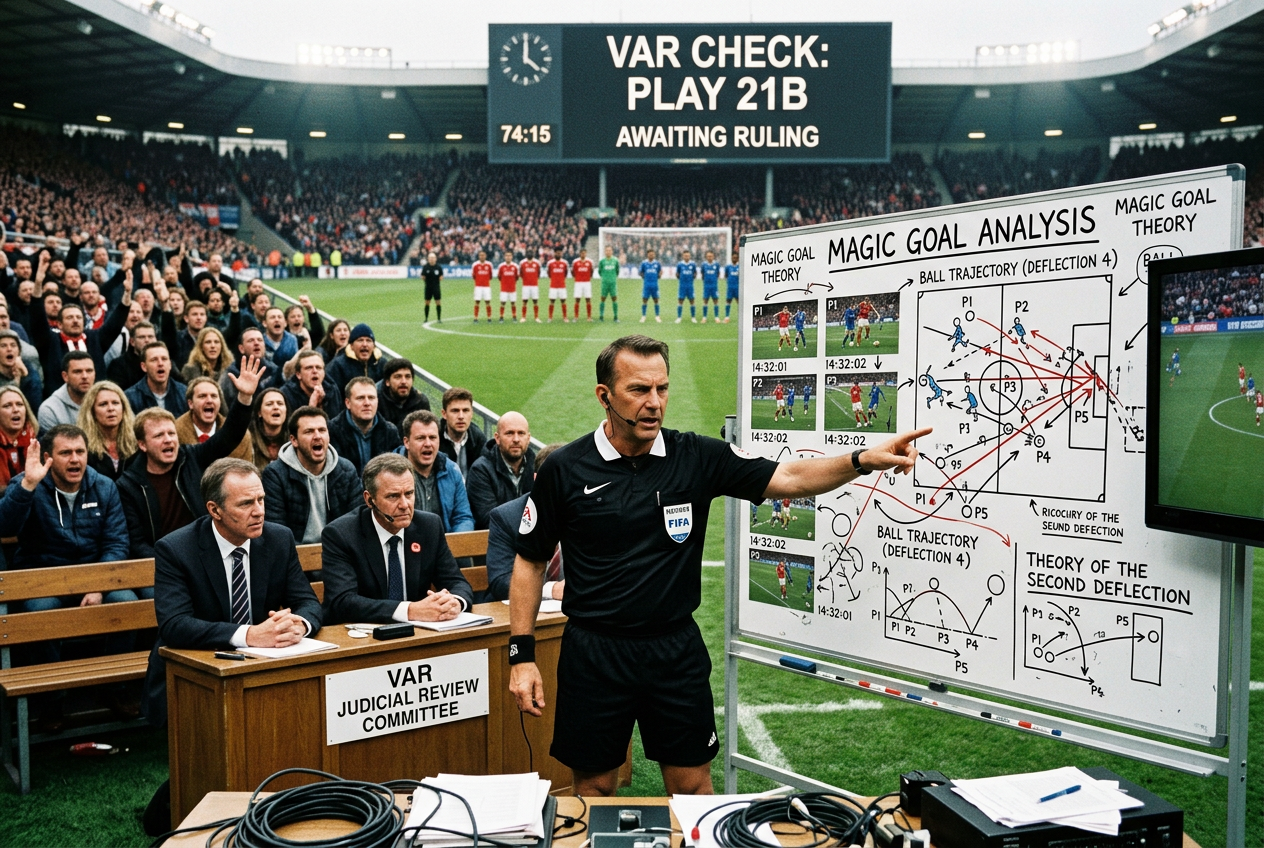
“As you can see, the striker was moving back… and to the left.”
We’ve saved the best — and probably the simplest — for last. Fixing VAR. The Video Assistant Referee might be one of the most important and transcendent innovations in any sport over the last generation or two. Purists will clutch their vintage scarves and insist that refereeing incompetence is part of the game, always has been, always should be. To which I say: that’s adorable, and also completely insane. Nothing — nothing — is more infuriating for a sports fan than watching your team lose because some zebra forgot his glasses, took a payoff, or momentarily forgot which sport he was officiating. We’ve all sat there, mouths open, hands in hair, trying to reconcile reality with what we just witnessed. VAR was supposed to fix that. A technological guardian angel. A truth machine. A divine rewind button.
But because this is soccer — and because we are apparently allergic to straightforward solutions — we turned that guardian angel into a bureaucrat. VAR didn’t just become a tool; it became a process. A ritual. A pilgrimage. Players stand around like they’re waiting for a delayed flight announcement at Heathrow while a disembodied voice somewhere in a bunker rewinds grainy footage frame by frame like it’s the Zapruder film. The stadium goes quiet, fans check their phones, and by the time a decision is made, you’ve forgotten what you were even mad about. Momentum dies. Emotion gets put in a chokehold. And then — then — after three minutes of existential dread, we get a call that somehow still feels wrong. Not because it is wrong, necessarily, but because the process has sucked every ounce of humanity out of it. We replaced chaos with confusion. We traded outrage for suspicion. We mechanized justice and somehow made it feel less fair.
Why Is VAR Important?
Because soccer, in its infinite stubbornness, waited until the rest of the sporting world had already figured this out. Every other major sport adopted replay like a rational adult adopting a GPS — because getting lost sucks, and Thomas Guides reduce your fuel economy by several miles per gallon. Football has reviews. Basketball has reviews. Baseball, the sport that once treated change like it was a communicable disease, now has reviews. Soccer showed up late to the party, wearing last decade’s outfit, pretending it didn’t need help. But here’s the truth: in most sports, a bad call is just a speed bump. Annoying? Sure. Fatal? Rarely. Missed pass interference? Get the next one. Weak hooking call? Kill the penalty. You can recover.
Soccer doesn’t give you that luxury. Soccer is a knife fight in a phone booth, that somehow lasts 90 minutes. One goal can decide everything. One call can tilt the entire universe and then lock it in place. There is no next possession that guarantees a shot at redemption. There is no margin for error, for the most critical of calls, anyway. And if a referee decides — correctly or incorrectly — that your guy deserves a red card? Congratulations, you’re now playing a man down for the rest of the match, like you’ve been sentenced to a slow, public execution. Imagine Draymond Green going nuclear on a ref, getting tossed, and then the Warriors just… don’t get to replace him. That’s soccer. That’s the level of punishment we’re dealing with. So yes, getting the call right matters. It matters a lot.
Which brings us to one of the most infamous moments in the sport’s history: the 1986 World Cup. Diego Maradona — a man who played soccer like gravity had personally offended him — scored what is now immortalized as the “Hand of God” goal against England. A goal that was, quite literally, punched into the net with his hand. Not subtly. Not debatably. Just… a full-on volleyball spike masquerading as divine intervention. The referee missed it. The world watched in disbelief. And the goal stood. Argentina advanced. England went home. History was rewritten by a missed call so egregious it still echoes decades later.
Now imagine VAR in that moment. Imagine a quick check, a calm correction, justice restored. No mythology. No controversy. No English tears for four running decades. Just the right call. That’s the promise of VAR. That’s why we need it.
What’s Wrong with VAR?
First, it takes freaking ages. We’re not talking about a quick pause — we’re talking about a full-blown intermission where everyone involved starts questioning their life choices. In one of the more egregious examples, it took nearly eight minutes to overturn a goal in a 2025 FA Cup match between AFC Bournemouth and Wolverhampton Wanderers. Eight minutes. That’s not a review, that’s a director’s cut. I’ve had more efficient oil changes. By the time the decision came in, players had cooled off, fans had emotionally processed three different outcomes, multiple popes died, and somewhere a guy had probably aged into a different tax bracket. VAR is supposed to enhance the game, not turn it into a hostage situation where we all just sit there waiting for someone in a bunker to rediscover the concept of certainty. The fix? Insultingly simple. One minute. Sixty seconds. 120 half seconds. If you can’t determine that the call should be overturned in that time, congratulations — you don’t have enough evidence. Monitor off. Comms dead. Call stands. We move on like functioning adults.
Second, some leagues use SAOT — semi-automated offside technology — which makes me want to sprint into traffic like I’m chasing a loose ball in stoppage time. The idea that we’re relying on a computer rendering to decide whether a follicle on a striker’s head drifted a millimeter beyond a defender is the kind of thing that makes you wonder if we’ve completely lost the plot. This isn’t justice; it’s forensic geometry. And let’s not pretend this is foolproof. Cameras have angles. Systems have margins of error. Data gets interpreted. But we treat these renderings like they were handed down on stone tablets from the soccer gods. Meanwhile, a goal gets erased because someone’s eyebrow was philosophically offside. The fix? Devastatingly simple. Can the naked eye definitively determine offside within 60 seconds? Great — make the call. If not, the call on the field stands. Done. The obvious gets fixed, the microscopic stays out of it, and we stop pretending that a 3D animation is the final arbiter of truth.
Third, it’s convoluted. VAR has rules, and then it has rules about the rules, and then it has exceptions to the exceptions that require a flowchart and a minor in philosophy to interpret. The scope is limited — which is good — but even within that scope, it feels like we’re constantly negotiating with the concept of clarity. Was it a clear and obvious error? Was it part of the same attacking phase? Did the moon align with Jupiter while the ball was in flight? Nobody knows. Players don’t know. Fans definitely don’t know. Half the time the referee looks like he’s explaining quantum physics using interpretive dance. The fix? I’m running out of creative ways to say easy. Strip it down. Two things only: goals and ejections. That’s it. Goals and red cards. That includes second yellows, violent conduct, diving — anything that either puts the ball in the net or a player in the locker room. Everything else? Let the game breathe.
Conclusion
Here’s the thing: VAR isn’t the villain. It’s the over-engineered, over-thought, over-handled solution to a problem that actually had a clean answer. We wanted fairness. We wanted the obvious mistakes corrected. We did not ask for a technological labyrinth that turns every big moment into a committee meeting. Soccer, at its core, is emotional chaos wrapped in ninety minutes of tension. It’s supposed to be imperfect. Its imperfection is what makes its beauty so transcendent. It’s supposed to make you feel something immediately, viscerally, and lastingly, without needing a forensic breakdown afterward.
Right now, VAR delays that emotion, dilutes it, and then hands it back to you slightly colder and infinitely more confusing. A last-minute goal should feel like an explosion. Instead, it feels like a cold case collecting dust in an FBI basement. Fans celebrate with one eye on the sideline, waiting for the invisible hand of review to either validate their joy or rip it away. That’s not drama—that’s anxiety.
But the fix isn’t surgical tumor removal. We don’t need to scrap VAR. We need to discipline it. Put it on a leash. One minute reviews. No microscopic offsides. Limited scope. Transparency. Treat it like a tool, not a co-star. Let referees referee, let players play, and let fans actually experience the game in real time instead of through the filter of a replay booth.
Because if we’re being honest, the best version of soccer isn’t played in a clean room, hooked up to monitors—it’s just fair enough that when your team loses, you can blame your players instead of a guy staring at a screen in a windowless cell. And that, in its own twisted way, is all we’ve ever really wanted.

Torsten
120 Proof Ball
Proof that the internet was a mistake.
