
NBA v. Everything
A lucid, intelligent, well thought-out objection
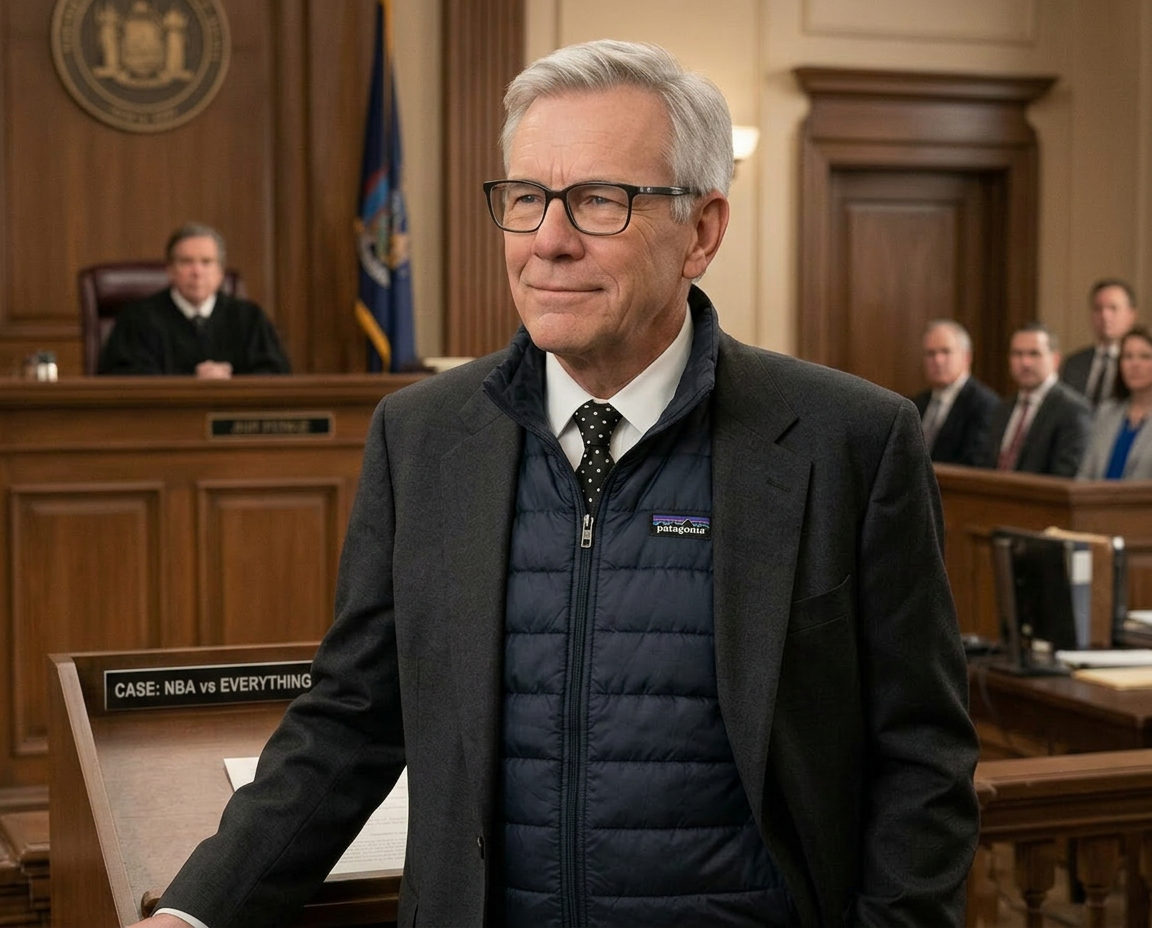
Jim Todder, III. “You can call me Todd, your Honor.”
Court was called to order just after noon, or what would have been noon if the morning docket had not already been delayed by a replay review and two sponsored reminders that the over was still very much alive.
Presiding was Judge Chamberlain Haller, who did not understand basketball, did not appear interested in understanding basketball, and had already developed a visible dislike for any sentence containing the words “load management,” “second apron,” or “competitive integrity.” The defense table was empty. At the prosecution table sat Jim Todder III, representing the people.
“You can call me Todd, Your Honor.”
He looked less like a trial lawyer than a man who had come directly from explaining duration risk to a nervous client. The Patagonia vest remained on. This was a man here to enter a season into evidence.
Judge Haller peered over his glasses, looked down at the file, and frowned. “Mr. Todd,” he said. “The court recognizes the prosecution. What is the first charge?”
I. Murder of Momentum
Todd stood. “Your Honor, the league stands accused of murder of momentum in the first degree.”
The judge blinked once. “That at least sounds like something I can understand. Proceed.”
Todd nodded. “The people intend to show that the modern NBA has taken a sport built on rhythm, escalation, and emotional continuity, and turned too much of it into administrative delay. A basketball game used to move like an argument. Now, too often, it moves like a permitting process.”
The judge shifted slightly in his chair.
Todd continued, “The charge is not that every game is bad. The charge is that the league has normalized a viewing experience that no longer respects the audience’s time. Replays. Reviews. Conferences. Monitor consultations. Possessions that die, then linger, then get autopsied under high definition. Fourth quarters that stretch like plea negotiations.”
Judge Haller frowned. “So this is about the games taking too long. What evidence can you enter into the record?”
“The people would enter this into the record, Your Honor: when UBS looks at Nike and warns that basketball may no longer be the cultural engine it once was for the brand, that is not some crank in a comment section. That is a major bank saying one of the NBA’s most powerful downstream commercial relationships may not carry the same force it used to. And when the world’s biggest basketball-adjacent apparel company is being discounted on that basis, we are no longer talking about vibes. We are talking about market signal.”
Judge Haller leaned back and looked around. “Alright,” he said. “And where is the defense?”
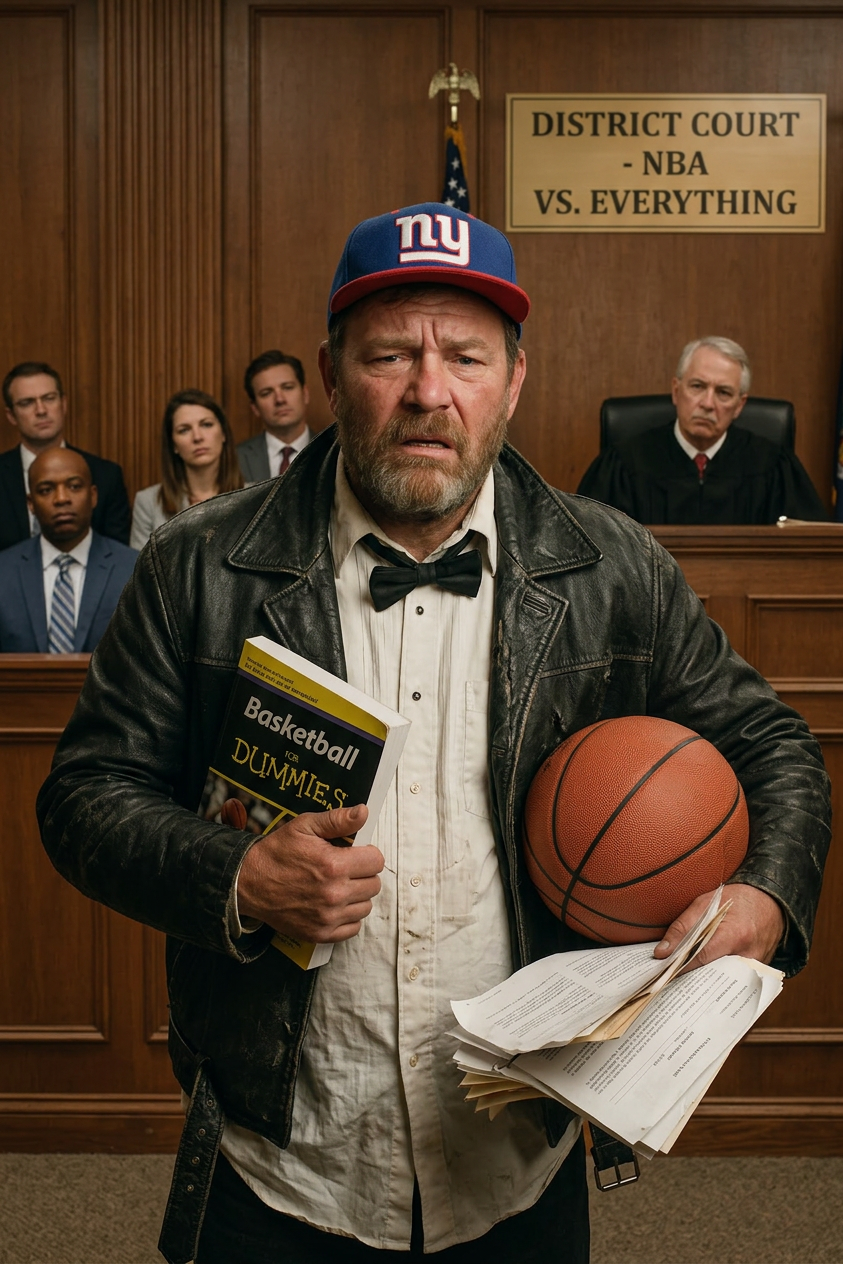
“Sorry, Your Honor. Parking.” — Torsten
Just then, the courtroom doors swung open. In stumbled Torsten — late, windblown, wearing a New York Giants hat, carrying a basketball under one arm and a copy of Basketball for Dummies under the other, with the expression of a man who had prepared extensively for the wrong hearing.
“Sorry, Your Honor,” he said. “Parking.”
Judge Haller stared at him. “And you are?”
Torsten adjusted the ball against his hip, replying, “Torsten. Counsel for the defense.”
The judge looked at the empty chair, then back at Torsten. “Where is the league’s usual staff counsel?”
Todd, without looking up, said, “Still trying to map Steve Ballmer’s financial records before they lose the will to live.”
The judge considered that. Then he looked back at Torsten. “So why did they send you?”
Torsten shrugged. “I’m his cousin.”
The judge let that hang in the air a beat longer than was kind. “Fine,” he said. “Counsel, the league stands accused of murder of momentum in the first degree. How do you answer?”
Torsten set the basketball down beside counsel table like it might somehow help. After flipping through his notes an uncomfortable amount of time, he continued.
“Game length has been consistently between two hours thirteen and two hours twenty minutes for years. Fans aren't just watching on TV anymore — streaming and social engagement is up. And, the viewing audience for games has grown 86% since last season. The league is growing — two new teams are slated to join the league in Las Vegas and Seattle.”
Todd gave a small nod, as if to say thank you for making the handoff easier than expected. “Very well,” he said. “Since counsel wishes to discuss growth, the people are prepared to discuss what kind of growth.”
II. Dilution of the Regular Season
Todd let the word growth sit there for a moment, then rose. “Your Honor, the people’s second charge is dilution of the regular season.”
Judge Haller looked down at the page. “Dilution,” he said. “As in watered down.”
“Yes, Your Honor.”
“Well,” said the judge, “that at least sounds like a thing a court can look into.”
Todd stepped out from behind the table. “The defense has informed the court that the league is growing. On that point, the people agree. Which is precisely the problem. The league is moving toward adding two more teams to a regular season that already feels overbuilt, overstocked, and increasingly unable to tell the audience which nights are supposed to matter.”
Judge Haller glanced up. “So this is not just about the season being long.”
“No, Your Honor. It is about the season being bloated. Eighty-two games across thirty-two teams asks an unreasonable amount of attention from any ordinary person with employment, children, or access to other forms of entertainment."
Torsten shifted in his seat.
Todd continued, “The people intend to show that the modern NBA regular season has become too large to feel consistently meaningful. You open League Pass on a Wednesday night and find yourself staring at a wall of glowing little rectangles, each one insisting it is important. Knicks-Hornets. Kings-Blazers. Hawks-Bulls. Jazz-Rockets. Analysis paralysis sets in.”
Judge Haller nodded slowly. “And then?”
Todd folded his hands behind his back. “And then, like many reasonable citizens overwhelmed by abundance masquerading as urgency, you just watch Heat again.”
The judge paused. “The Pacino one?”
“The Pacino one.”
“Good,” said Judge Haller. “Proceed.”
Todd gave the smallest nod, “Outside of the nationally televised match-ups, the games stop feeling like events and start feeling like inventory. Too much of the product now arrives in an undifferentiated flood.”
Torsten rose. “Objection, Your Honor.”
Judge Haller looked at him. “On what grounds?”
Torsten hesitated. “On grounds that the prosecution is criminalizing choice.”
“Overruled,” said the judge. “I have looked for something to watch on Netflix. I understand his point.”
Todd resumed, “The league has also taught everyone involved exactly how much of the regular season is functionally negotiable. When the NBA set the meaningful threshold for postseason awards at sixty-five games, sixty-five games became the real season.”
The judge leaned slightly forward, “What does that mean for the other seventeen games, then?”
“They become optional. Medical staff uses the term load management. The best players get the night off.”
“Do the people intend to present any evidence of this behavior?”
"This season, Cade Cunningham returned from a collapsed lung to log a five-minute appearance that preserved a path to awards eligibility. Luka Dončić also wound up needing extraordinary-circumstances relief after finishing just below the threshold due to missing one game for birth of his child. When the health staff is solving for seventeen games of load management, real health and family issues become extraordinary circumstances.”
Judge Haller frowned. "Defense, what do you say to these charges?"
Torsten stood again, now with the air of a man who believed he had finally found a foothold. “The defense would remind the court,” he said, “that the league has, in fact, created successful new forms of regular-season urgency.”
Torsten straightened his cap. “The NBA Cup has been a success. Fans responded. Players responded. The league created higher-stakes games in November, and the audience showed up for them.”
The judge glanced down at the docket. “Anything further?”
Todd did not sit. “Yes, Your Honor,” he said. “If the regular season has been diluted, then what remains inside it is too often no longer competitively serious.”
Judge Haller closed his eyes. “So now we get to the losing.”
“In part, yes.”
“Of course we do.”
III. Competitively Compromised Basketball
Todd stepped forward and turned the easel toward the bench. “The people’s third charge is competitively compromised basketball.”
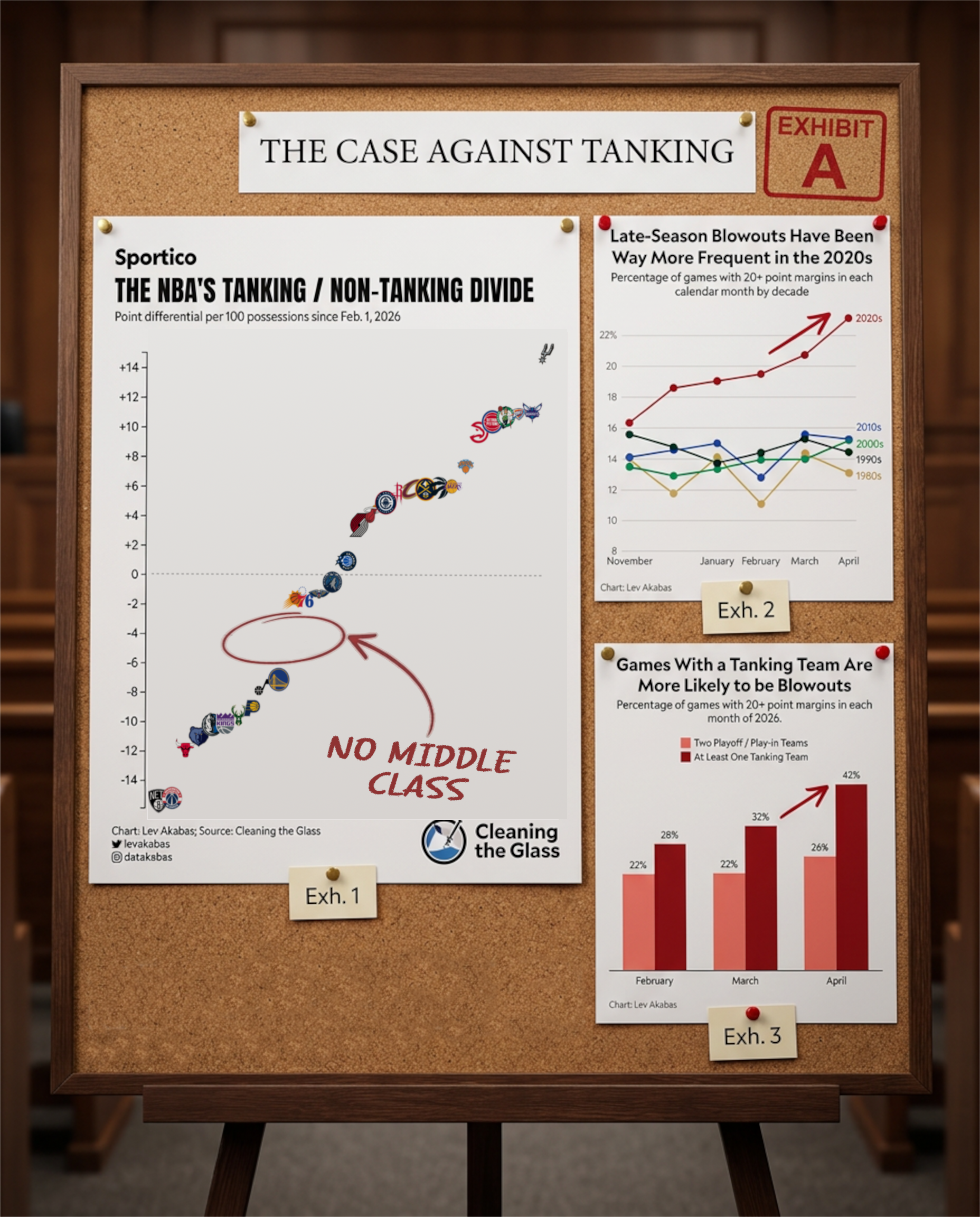
Judge Haller looked down at the page, then up at the board. “That,” he said, “appears to be a corkboard.”
“It is, Your Honor.”
“With arrows.”
“Yes, Your Honor.”
The judge nodded once. “Good. The court responds well to arrows.”
Todd rested a hand on the frame. “In 2026, late-season blowouts reached historic levels. By the final month of the season, more than one out of every three games was no longer meaningfully competitive.”
Judge Haller frowned. “That is a lot of public executions.”
Todd nodded, tapping the chart on the lower right. “And when at least one tanking team was involved, those blowout rates climbed even higher. Games between two playoff or play-in teams were decided by 20 or more 26% percent of the time in April. But when one team was tanking, the game was a blowout 42% of the time.”
The judge looked up. “Forty-two?”
“Yes, Your Honor. Which suggests the problem is not merely variance, pace, or modern shot selection. A major part of the answer is that too many teams are no longer pursuing the same objective.”
Todd pointed to the large chart on the left, “The league has separated into two classes: functioning teams and strategic wreckage. There is now empty space where the competitive middle used to live.”
He let that sit a beat.
“To combat this problem, the league is merely handing out parking citations. This season, Utah was fined for conduct detrimental to the league. Dallas too found it cheaper to eat a fine than to risk winning. More teams than ever are not trying to win games.”
Torsten rose, “The defense would remind the court that the league is not ignoring the problem.”
Adjusting his cap, he explained, “The Board of Governors is considering anti-tanking reforms. One proposal would expand the lottery to twenty-two teams. The idea is simple: if more teams have a shot at moving up, fewer teams will feel compelled to race to the bottom. The league recognizes the incentive problem and is attempting to reduce it.”
“The defense would submit that expanding the lottery reduces the payoff for blatant tanking while keeping more of the league engaged. Serious reform.”
Judge Haller considered the board, then the defense table.
“So your position,” he said, “is that the league sees the disease and is working on a cure.”
“Yes, Your Honor.”
Judge Haller looked down at the docket, then at the clock, then back at the docket with the expression of a man beginning to suspect that basketball had been invented specifically to inconvenience him. “Do you have further charges?” he asked.
Todd glanced at the file, “The next charge, Your Honor, concerns the increasingly creative ways teams explain why healthy-looking players cannot seem to play basketball.”
Judge Haller shut his eyes. “Injury reports.”
“Yes, Your Honor.”
The judge exhaled through his nose. “Counsel,” he said, “I’m going to level with you. I have a football game in three hours, and every time you say the phrase ‘injury report’ I feel that window narrowing.”
Before Todd could answer, the courtroom doors opened again.
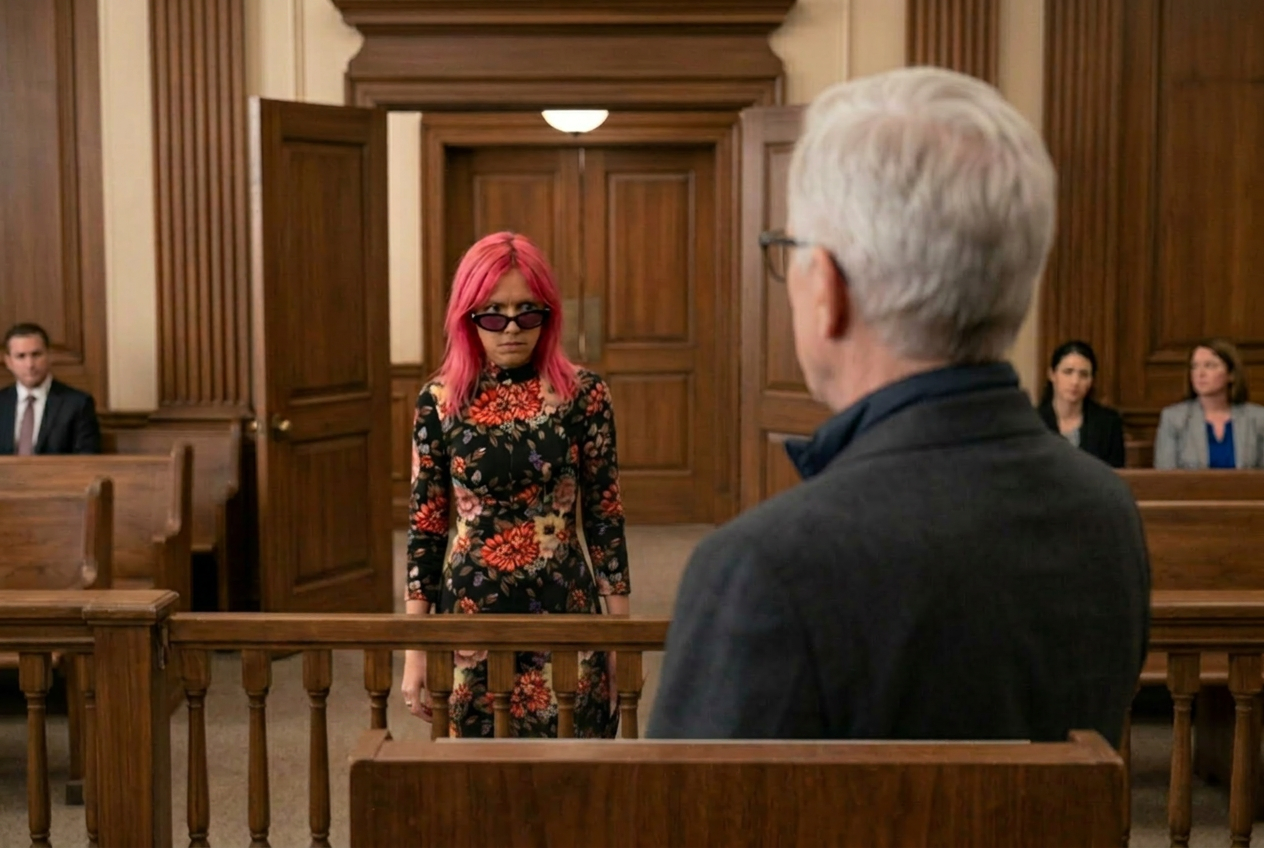
“You were supposed to pick up the good pita thirty minutes ago.” — Mona Lisa Dorito
Mona Lisa Dorito stepped inside, took one look at Todd, and stopped. She did not wave. She did not smile. She simply gave her husband the wide-eyed, tight-lipped look of a woman who had texted thirty minutes ago about stopping at the store and was now being forced to discover that the errand had lost to a live prosecution of the modern NBA.
Todd, to his credit, did not visibly react. To his discredit, he did glance down at his phone.
Judge Haller followed the movement. “Friend of the court?” he asked.
Todd cleared his throat. “No, Your Honor.”
Dorito said nothing. She moved to the gallery, sat down, and folded her arms with the patient severity of someone willing to let this continue only long enough to confirm that everyone involved was, in fact, being stupid on purpose.
Judge Haller watched her settle in, then looked back to Todd.
“Fine,” he said. “But I want the record to reflect that another person has now entered this courtroom looking disappointed in you.”
IV. Falsification By Injury Report
“Yes, Your Honor.” Todd straightened the file in his hands. “The people’s fourth charge is falsification by injury report.”
Judge Haller looked up. “That sounds criminal.”
Todd said. “The people’s case is broader than that. The charge is not merely that teams sometimes hide behind medical language. The charge is that the modern NBA has built a system in which the public can no longer reliably tell the difference between actual incapacity, prudent caution, and strategic unavailability.”
Todd opened the file. “The people do not dispute that players get injured. They do. Team doctors exercise caution for all the right reasons. That’s also true. The problem is the fan experience. A ticket is sold because a fan wants to see a star. That family may get to attend one game all year. They see their hero is upright, dressed, alert, talking, perhaps even insisting he feels fine. The team says precaution. The injury report says soreness, management, inflammation, bruise, or anything else that would have your P.E. teacher suggesting to just rub some dirt on it.”
Judge Haller leaned back. “That does sound annoying.”
Todd nodded. “After the Jazz fell to 25th, Lauri Markkanen was ruled out with what the Jazz described as ‘symptomatic hip impingement with associated inflammation and a bone bruise.’”
Judge Haller stared at him. “Counsel, that sounds less like an injury report than a paragraph written to avoid follow-up questions.”
Todd gave the slightest nod. “Utah did not simply rule him out and move on. They placed him into rolling re-evaluations while the season dissolved around him. This from an organization the league had already fined $500,000 in connection with roster management decisions involving healthy players. Markkanen spoke out — he said ‘it was frustrating, that you want to play every game, especially home games, and that it was a bummer sitting on the bench seeing the fans come support the team while he could not be out there.’”
Torsten rose. “Objection, Your Honor.”
Judge Haller looked up. “On what grounds?”
“On grounds that no one has ever purchased an NBA ticket because they were hoping to see Lauri Markkanen.”
Judge Haller considered this. “Overruled,” he said. “Also, that was mean.”
Todd continued, “The people are not alleging bad faith there. They are alleging something more fundamental: if sitting a healthy-enough star is prudent, then the season has become so long that ticket-buying fans are being asked to subsidize prudence itself.”
Checking the temperature of the room, Todd glanced toward his wife. For the moment, Mona Lisa Dorito looked less irritated than interested.
He pressed on. “And then there is Giannis Antetokounmpo. A franchise player. A former champion. After suffering a hyperextended knee and bone bruise, Giannis reportedly pushed to return, told the Bucks he believed he was healthy enough to play, and was overruled by the team and its medical staff.”
Judge Haller looked up. “So even he could not get himself cleared. Does the defense have a rebuttal?”
Torsten stood again, seeming confident he had located the right page in his notes, “The defense would caution the court against mistaking isolated incidents for a leaguewide pattern. Teams have an obligation to protect players, even from themselves. And the participation rules have plainly changed behavior. Even Kawhi Leonard, patron saint of selective availability, played 65 games this season after averaging only 48 since 2017.”
Then Judge Haller looked down at the docket, then at the clock, and back at the prosecution. “In what I can only describe as an act of mercy,” he said, “am I to understand the next charge is your last?”
V. Improper Alignment With the Gambling Ecosystem
“Your Honor,” Todd said, “the people’s final charge is improper alignment with the gambling ecosystem.”
Todd nodded. “The people’s claim is not that gambling exists. That ship has sailed. It has a sportsbook in the atrium now. The claim is that the modern NBA has become too comfortably organized around a betting environment that monetizes statistical minutiae and benefits every time the game stops to inspect itself under fluorescent light.”
Judge Haller squinted. “You are telling me replay review has a constituency?”
“Yes, Your Honor. Every extra review, every fingertip reversal, every assist that becomes not an assist, every rebound that gets adjudicated like mineral rights in a border dispute — all of it serves an ecosystem that increasingly treats the game not as a contest, but as a series of tiny financial outcomes. ESPN reported the league was projected to receive $167 million in revenue from casinos and betting for the 2023–24 season. Quite the constituency, in fact.”
The judge frowned, checking his watch. “We already covered replay review. Do you have any other evidence, counsel?"
“The real problem is incentives, Your Honor. Not every staff member in this league makes All-Star money. Inside information on a prop bet can mean life changing money in the right hands. The federal government has already alleged that Terry Rozier told a longtime friend he would remove himself early from a game because of a supposed injury, allowing bettors with that information to hammer the under before the public knew what was happening.”
He flipped to the next page, “Former NBA player and assistant coach Damon Jones is now expected to plead guilty in a federal gambling sweep after prosecutors alleged he sold nonpublic injury information to bettors, including information involving LeBron James and Anthony Davis while working around the Lakers.”
“While the NBA certainly cannot afford another Tim Donaghy officiating scandal, these kinds of incentives create the environment where it can happen. Worse, staff members, players and their families have received threats to their safety from disenchanted bettors.”
Torsten stood slowly, with the expression of a man about to defend a kitchen fire by praising the quality of the smoke detectors. “The defense would remind the court,” he said, “that the league is not asleep at the wheel. It has tightened injury reporting, expanded compliance education, and lobbying to reduce the maximum bet on the most manipulable prop offerings, including limiting ‘under’ bets. It is employing AI to monitor betting activity more closely. Further, the NBA has updated its Fan Code of Conduct, to better protect players, coaches, personnel and their families from threats and harassment.”
From the gallery came a sound. Not quite a laugh. Not quite a sigh. More the noise a grown woman makes when she has just heard the dumbest professionally formatted sentence of her entire week.
Judge Haller looked up.
Mona Lisa Dorito had not moved much, but her face had. She now wore the unmistakable expression of someone who had entered this courtroom mildly annoyed about an errand and was preparing to leave actively offended by management theory.
The judge adjusted his glasses. “Ma’am,” he said, “you appear to be reacting to counsel.”
Dorito folded her arms tighter. “Reacting? Oh I’m just getting started.”
Everything That Guy Just Said is BS
Judge Haller adjusted his glasses to make sure he was correctly seeing Dorito strolling up to the witness stand with the expression of a woman who had not planned to testify but had finally lost confidence that anyone else in the building could identify a kitchen fire.
“Ma’am,” he said, “before this court lets you interrupt counsel, I need to understand what exactly qualifies you to speak on hard-to-watch basketball.”
Dorito adjusted her microphone and leaned in. “I was a Brooklyn Nets fan during the Nic Claxton era.”
The judge paused, hearing gasps in the jury.
Todd gave a small nod. “That is true, Your Honor.”
Judge Haller looked back to the witness. “The court will recognize her as an expert.”
Todd took a deep breath, decided to go with God, and asked, “I get the feeling that you have some notes.”
“The defense is wrong.”
Torsten straightened in his chair. “On which point?”
Dorito tilted her head. “Which one would you like back first?”
Judge Haller raised a hand. “One at a time, please. I’m old.”
Dorito nodded. “Fine. Let’s start with viewership.” She turned toward Torsten. “You keep talking like the audience doubled because the product got healthier. Most of that surge came from a measurement change — Nielsen Ratings switched from Panel data only to Panel + Big Data. They’re now counting somebody on a social media site who taps to view some live game footage on their phone as a viewer.”
“Here’s a real world test. Ask yourself whether almost twice as many people in your actual life are excited about basketball this season. Engaged. Talking about it.”
Torsten opened his mouth.
Dorito kept going. “If the answer is no, then what you have is not a clean referendum on the product. You have a larger number being used to answer the wrong question.”
Judge Haller nodded slowly. “That is the first thing anyone has said in here that sounds like it was tested on regular people.”
Dorito went on. “Then there’s the NBA Cup. Counsel keeps citing it like a cure. It isn’t. Its existence is an admission. If your regular season were healthy, you would not need to bolt a side tournament onto November. And even then, the league never gave it a real structural reward. No standings edge. No tiebreaker. No half-game advantage. Instead they just bribe the players with cash bonuses to take it seriously.”
She glanced toward Torsten. “Last season, the NBA Cup saw its Ratings fall 33%. This season’s NBA Cup featured Victor Wembanyama and the Knicks, and benefitted from the aforementioned Nielsen ratings measurement change. The ratings were only 3% better. It’s a gimmick that proves the underlying problem.”
Judge Haller frowned. “So your position is that the patch is evidence of the leak.”
“Yes,” said Dorito. “That is generally why patches exist.”
Torsten tried to regroup. “The league is still innovating—”
“No,” Dorito said. “It is compensating.”
The judge made a note. He looked pleased with it.
She explained, “Baseball innovated. The MLB changed their product in 2023 — shortened the games, improved the pace. When you back out the NBA’s magic counting tricks and just look at viewership on single networks like ESPN and ABC, MLB has seen organic growth that has doubled the NBA’s in the three years since their change, with their best growth coming from viewers under age 17 — where the NBA has historically dominated. The NBA just got better at counting.”
Torsten opened his mouth as if to reply, only to find that she wasn’t done.
“And then there’s tanking. Counsel wants credit because the league is considering reforms. Wonderful. One of the proposals expands lottery eligibility to twenty-two teams. Which sounds clever right up until the first franchise realizes it can tank its way out of the first round. The incentive does not disappear. It infects the postseason.”
Judge Haller looked up. “So when he says the league is working on it—”
“They’ve formed a committee, Your Honor.”
Torsten slumped slightly.
Dorito did not look at him. “And the injury reports. This is the part that grinds my crank - teams are insulting the public in medical language. Giannis matters here — because he is one of the only ones powerful enough to say the problem out loud. ESPN reported that he believed he was healthy enough to play and was overruled by the Bucks. He’s a franchise player currently searching Zillow for Miami real estate. For every Greek Freak, there are probably plenty of other players who feel the same and keep quiet because they still have to work with their team staff and teammates the next day.”
Judge Haller interjected, “The jury will note that this is inference, not evidence.”
“Rather than handing out citations when they catch a team in the act of gaming the injury list, the NBA should consider whistleblower protections for players who report their team fabricating injuries.”
She turned, finally, toward Torsten. “And that brings us to the league’s cozy relationship with gambling.”
Torsten gave a weak little lift of his hands. “The NBA has tightened injury reporting, expanded compliance education, pushed to narrow certain prop bets, increased monitoring, updated the fan code of conduct — ”
Dorito stared at him. “A fan code of conduct?” she repeated. “That’s the answer? Death threats are coming in from bettors and the league decided to roll with workplace-poster energy?”
The room was quiet now.
“The memo proves the problem is real,” she said. “You do not roll out more game-day injury disclosures, more compliance education, and more lobbying against single-play props because everything is fine. You do it because the ecosystem got dangerous, because now the FBI is sniffing around enough that the league had to present the appearance of action.”
Torsten began locating his nearest emergency exits.
“And spare me the engagement argument. People would still bet on basketball if the league stopped taking gambling ad money tomorrow. The games would still exist. The apps would still exist. The degenerates would still be out there designing nine-way parlays. So this is not the league choosing between fan interest and no fan interest. It is choosing whether to cash checks from the same gambling platforms it later claims it needs help reining in.”
Judge Haller looked at Todd, “How much money do teams make off of these gambling ads?”
Todd produced a HP12C calculator, “Let’s see, $167M per year as of 2023-24, which sounds meaningful. But once you add two new teams, back out the league’s rake and taxes, each team likely nets only $1.5M to $2.6M per year. Enough to buy them a nice Bronny James or Thanasis Antetokounmpo.”
Dorito nodded. “Exactly. And the league would have more credibility lobbying to restrict the most manipulable prop bets if they were not also in business with the people selling them.”
Torsten made one last attempt. “So what are you saying? That the league should reject growth? Reject innovation? Reject revenue?”
Dorito looked at him with something just short of pity. “No,” she said. “I’m saying you have not defended the experience once. Not once. Every time the prosecution described something miserable, diluted, compromised, evasive, or corrosive, you answered with reach, process, committees, safeguards, and money.”
She turned toward the bench. “That is why everything he says sounds so stupid.”
Judge Haller sat very still.
Dorito delivered the last line without raising her voice. “They keep defending the health of the product with the wealth of the asset.”
Judge Haller looked toward the prosecution table. “Anything to add, counsel?”
Todd nodded, “Only that I can’t fathom why this woman tolerates me, Your Honor.”
Ghoul and Unusual
Torsten shot to his feet. “Mistrial.”
Judge Haller blinked. “On what grounds?”
“Juror bias.” Torsten said.
The judge frowned. “Be specific.”
Torsten pointed toward the jury box. “Juror Number Eight is a Sixers fan.”
The room turned. Juror No. 8 sat with his arms crossed in a black Sixers hoodie, an Allen Iverson tattoo running down his forearm and the expression of a man who had trusted The Process with parts of his soul that were never returned.
Judge Haller studied him for a moment. “Counsel, the court is not prepared to rule that being from Philadelphia disqualifies a man from civic duty.”
Torsten stepped forward. “Your Honor, with respect, this is not ordinary fandom. That man has lived through Andrew Bynum’s bowling injury, Ben Simmons discovering the concept of passing up a layup in real time, Doc Rivers personal crusade against competency after going up 3-2 in the semis, and whatever it was Joel Embiid’s knees were trying to negotiate with history. He is not a juror. He is trauma with voting rights.”
Juror No. 8 did not blink.
Judge Haller rubbed his temple. “I’ll grant you he appears burdened. However, I will not grant a mistrial on the basis of sports-related spiritual fatigue.”
“Well, since we’re talking about spiritual fatigue — fine. Let’s discuss the ghost,” he said, pointing again.
There was a pause. “A sentence,” Judge Haller said carefully, “I had not expected to hear today.”
Torsten did not lower his arm. “Beside Juror Number Eight, Your Honor.”
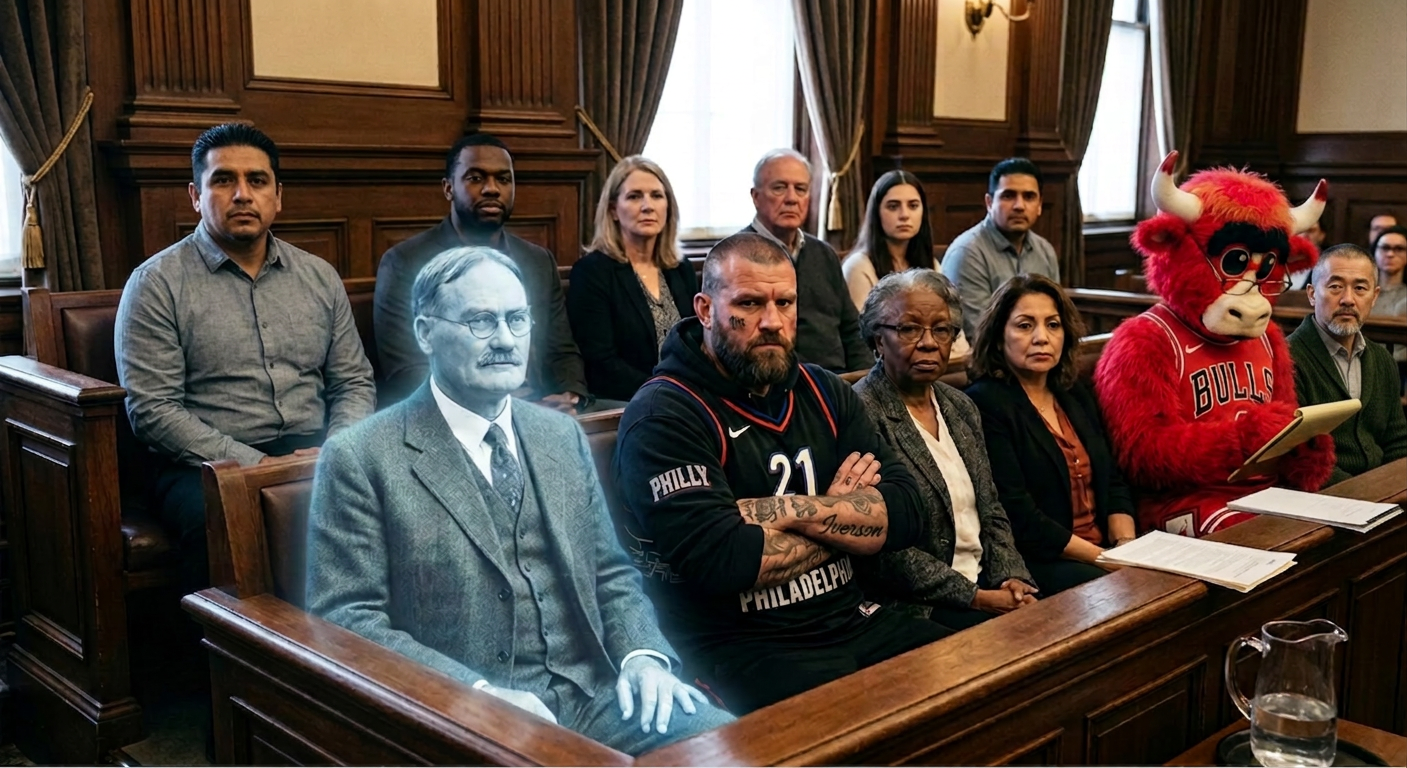
The courtroom turned again. There, seated neatly with hands folded in his lap and glowing with the grave, disappointed calm of a man who had once invented a peach-basket game for exercise and now had to watch gambling props, replay review, and second-apron discourse metastasize around it, sat the ghost of James Naismith.
For a long beat, nobody said anything. Then Todd rose. “Objection. The non-corporeal do not possess a vested interest in earthly affairs.”
Torsten turned on him instantly. “Then why is he here?!”
The room paused. Torsten pointed again, now with the confidence of a man who had finally found one loose brick in a collapsing wall. “Well? He showed up, didn’t he? Most dead people had the good manners to stay home.”
Naismith’s ghost remained seated, glowing with dignified irritation.
For the first time all afternoon, Judge Haller looked genuinely torn. He removed his glasses. He looked at the jury box. He looked at Torsten. He looked at Todd. He looked at Dorito, who had already mentally left the building and was now just waiting to see which grown man would embarrass himself last.
Finally he exhaled. “This court finds,” he said, “that while the prosecution has raised several credible concerns regarding the modern NBA, the proceedings themselves have deteriorated past the point of institutional dignity.”
Torsten nodded solemnly, as though he had not personally helped drag them there by the ankle.
“Accordingly,” Judge Haller continued, “I am declaring a mistrial.”
Todd stood. “Your Honor, the people object.”
Judge Haller was already gathering his papers. “The people have had all afternoon. This matter is dismissed without prejudice, without closure, and without any expectation that it will improve on its own.”
He stood. “And because I have now spent three hours listening to arguments about replay review, tanking incentives, fake injuries, prop-bet contamination, and the metaphysical legal status of Dr. James Naismith, I am leaving to watch football, a sport with the dignity to be purely, unapologetically stupid.”
With that, Judge Chamberlain Haller stepped down from the bench and disappeared through the side door.
Todd might have lingered in disappointment, but self-preservation kicked in first — there was still the matter of picking up the good pita bread, macaroni salad, and, apparently, fabric softener again.
AUDITING THE MYTH SINCE 2006

If you made it this far, you already know what we do here. We write about greatness and delusion, triumph and collapse, and the strange emotional hold sports keeps on people who should probably know better.
Drop your email and once a week we’ll serve you something from the top shelf — no cheap shots.

Torsten
120 Proof Ball
If you liked this then you’re part of the problem.
